Open Today Sales: 9 AM-9 PMOpen Today Service: 7 AM-7 PM
Toyota offers 4-wheel drive (4WD) or all-wheel drive (AWD) across nearly every segment of its lineup. Sedans and hatchbacks like the Camry, Crown and Prius come with available or standard AWD. Crossovers including the RAV4, Highlander, Grand Highlander and Corolla Cross use electronically managed AWD systems. And the body-on-frame trucks and SUVs — Tacoma, Tundra, 4Runner, Sequoia and Land Cruiser — use part-time or full-time 4WD with a two-speed transfer case.
Which system you want depends on what you actually drive through. This guide covers which Toyota models offer each system, and what all-wheel drive costs across the lineup in both price and fuel economy. It also covers how to shift a Toyota into 4WD, and when you should not.
| Segment | Toyota Models | Drivetrain System |
|---|---|---|
| Sedans & Hatchbacks | Camry, Crown, Prius | Available or standard all-wheel drive |
| Crossovers & SUVs | RAV4, Highlander, Grand Highlander, Corolla Cross | Electronically managed AWD, including Electronic On-Demand AWD on hybrids |
| Body-on-Frame Trucks & SUVs | Tacoma, Tundra, 4Runner, Sequoia, Land Cruiser | Part-time or full-time 4WD with a two-speed transfer case |
Toyota’s cars and crossovers use compact AWD systems built for rain, light traction and cornering stability rather than off-road work. The Camry, Prius, Corolla Cross, RAV4 Hybrid and Grand Highlander all offer all-wheel drive as an option on at least some grades. On the Crown, the Corolla Cross Hybrid and every 2026 Highlander, it is standard — Toyota dropped front-wheel drive from the Highlander this year and discontinued the LE grade, leaving XLE as the entry point.
Hybrid models such as the RAV4 Hybrid and Highlander Hybrid use Electronic On-Demand AWD. An independent rear electric motor drives the rear axle the moment the system detects front-wheel slip, with no driveshaft running to the back of the vehicle. On the RAV4 Hybrid that rear motor also lifts output to 236 horsepower, against 226 on front-drive grades. Drivers heading up the foothill routes near Pasadena get that traction without touching a switch. For a closer look at one lineup, see the 2026 Highlander and Highlander Hybrid trims, pricing and MPG breakdown or browse Toyota crossovers and SUVs.
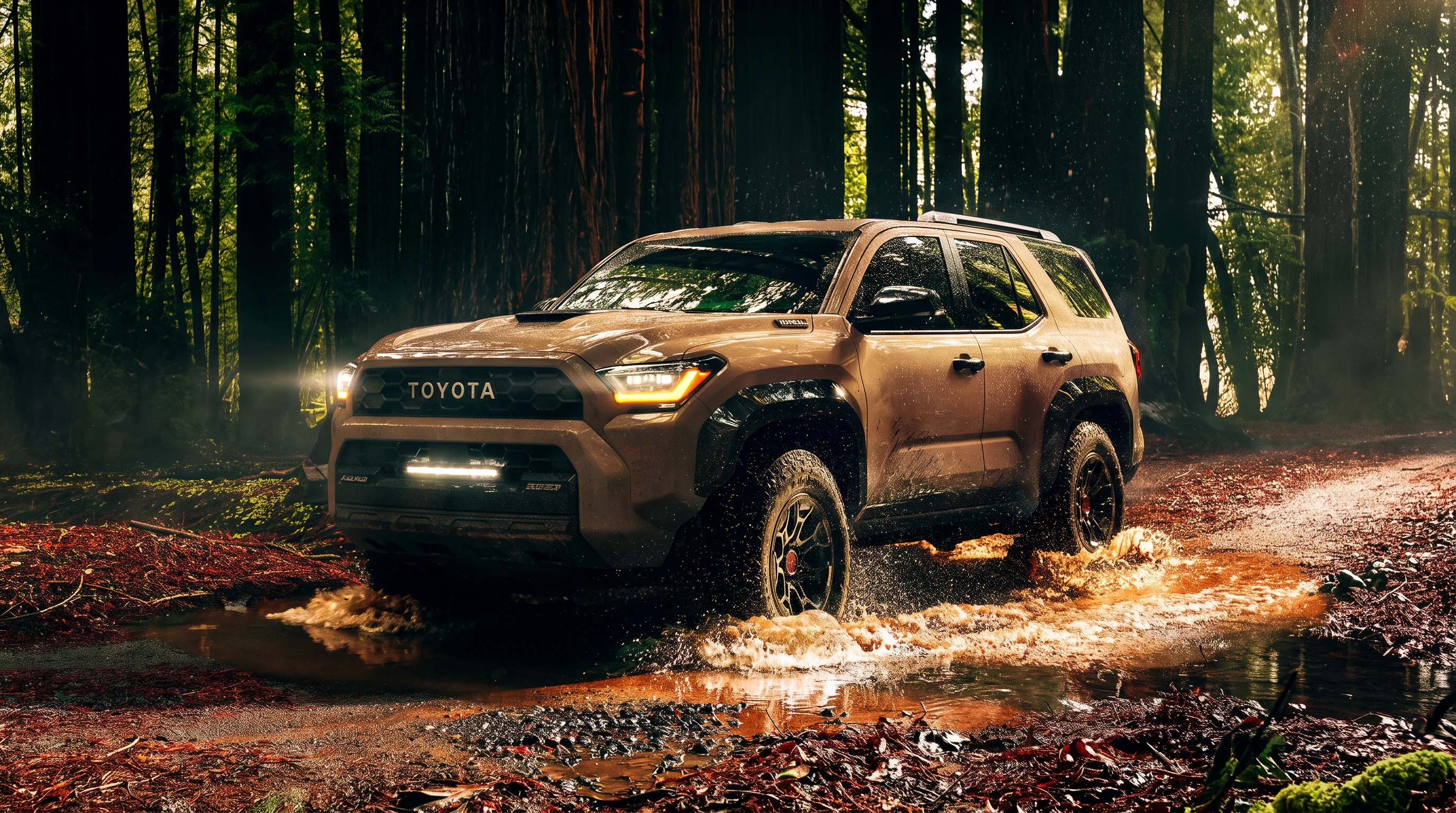
The Tacoma, Tundra, 4Runner, Sequoia and Land Cruiser take a different approach entirely. They use mechanical transfer cases, high and low gear ranges, and locking differentials built for trail conditions rather than wet freeway on-ramps. The Tacoma, Tundra, 4Runner and Sequoia all start as rear-wheel drive with four-wheel drive available, while the Land Cruiser comes with full-time 4WD as standard. Browse the full range of Toyota trucks to compare configurations.
Driving all four wheels adds weight and mechanical drag, so both systems cost a little fuel economy. Across the 2026 lineup that penalty is small — usually one to three mpg combined. The table below uses the official ratings published by the EPA, comparing each model’s base two-wheel-drive configuration against its all-wheel or four-wheel-drive equivalent.
| 2026 Toyota Model | EPA-Estimated Combined, FWD or 2WD | EPA-Estimated Combined, AWD or 4WD | Difference |
|---|---|---|---|
| Prius | 57 mpg | 54 mpg | 3 mpg |
| Camry | 51 mpg | 50 mpg | 1 mpg |
| RAV4 Hybrid | 43 mpg | 42 mpg | 1 mpg |
| Corolla Cross | 32 mpg | 30 mpg | 2 mpg |
| Grand Highlander | 24 mpg | 23 mpg | 1 mpg |
| Highlander | Not offered for 2026 | 24 mpg | AWD standard on every grade |
| Highlander Hybrid | Not offered for 2026 | 35 mpg | AWD standard on every grade |
| Tacoma | 22–23 mpg | 21 mpg | 1–2 mpg |
| 4Runner | 22 mpg | 21 mpg | 1 mpg |
| Sequoia | 22 mpg | 20 mpg | 2 mpg |
| Tundra | 20 mpg | 19 mpg | 1 mpg |
EPA-estimated fuel economy figures are for comparison purposes only. Your actual mileage will vary depending on driving conditions, how you drive and maintain your vehicle, battery age/condition, and other factors.
Figures also move by grade within a single model, usually because of wheel and tire packages. RAV4 Hybrid AWD runs from an EPA-estimated 42 mpg combined on LE and SE down to 38 mpg on Woodland. Highlander Hybrid AWD rates 35 mpg highway on XLE against 34 mpg on Limited and Platinum. Transfer case type matters too. 4Runner part-time 4WD is EPA-estimated at 19 mpg city and 25 mpg highway. Full-time 4WD trades a point in each direction, at 20 mpg city and 24 mpg highway.
EPA-estimated fuel economy figures are for comparison purposes only. Your actual mileage will vary depending on driving conditions, how you drive and maintain your vehicle, battery age/condition, and other factors.
Towing capacity tracks body structure and powertrain more than drivetrain. The gas Highlander AWD tows up to 5,000 lbs and the Highlander Hybrid AWD up to 3,500 lbs, while the body-on-frame 4Runner tows up to 6,000 lbs.
Maximum towing and payload capacity figures are based on properly equipped vehicles and vary by configuration. Do not exceed any weight rating. See your owner’s manual and the vehicle’s door-jamb label for specific capacities.
| System | How It Works | Where You’ll Find It | Safe on Dry Pavement? |
|---|---|---|---|
| Electronic On-Demand AWD | An independent rear electric motor drives the rear axle when the system detects front-wheel slip. No center driveshaft. | RAV4 Hybrid, Highlander Hybrid and other Toyota hybrid models | Yes — safe for continuous use |
| Part-Time 4WD | A two-speed transfer case locks the front and rear driveshafts to the same speed. There is no center differential. | 4Runner SR5 and TRD grades, Tacoma, Trailhunter, TRD Pro | No — low-traction surfaces only |
| Full-Time 4WD | Drives all four wheels continuously through a center differential with an electronic lock. | 4Runner Limited and Platinum, Land Cruiser | Yes — safe for continuous use |
Four-wheel drive is not standard on the base grades of the Toyota 4Runner and Tacoma. The 4Runner SR5 and Tacoma SR both start as rear-wheel drive, with an Automatic Limited-Slip Differential (Auto LSD) handling light traction. Part-time 4WD is available from there. It is standard on the off-road grades — TRD Off-Road, TRD Pro and Trailhunter — and each of those also gets an electronic locking rear differential. Every i-FORCE MAX hybrid model comes standard with four-wheel drive.
According to Toyota’s 2026 4Runner specifications, four-wheel-drive models use an electronically controlled two-speed transfer case with high and low range. Active Traction Control (A-TRAC) manages wheel spin across uneven terrain. The Limited and Platinum grades go further, with full-time 4WD and an electronic locking center differential that allows continuous four-wheel traction on any pavement surface.
Multi-Terrain Select operates in both 4WD-High and 4WD-Low on off-road grades, adjusting throttle response and braking intervention for mud, dirt, sand or rock. For a grade-by-grade look, see the 2026 Toyota 4Runner overview and the 2026 Toyota Tacoma features and specs.
Switching into four-wheel drive on a compatible Toyota takes seconds. The steps differ depending on whether you want 4WD High or 4WD Low.
Can you shift into four-wheel drive while moving? Yes — for 4H only. Most modern Toyota trucks and SUVs with part-time 4WD offer shift-on-the-fly capability, provided the front wheels are pointed straight ahead and not spinning. Check your owner’s manual for the maximum speed at which your vehicle permits the shift. Entering 4L always requires a complete stop.
This guide applies to Toyota models equipped with part-time or full-time 4WD systems. Always refer to your specific vehicle’s owner’s manual for detailed instructions and safety information.
No. You should never drive a Toyota in part-time 4WD High or 4WD Low on dry, high-traction pavement. A part-time transfer case locks the front and rear driveshafts together at the same speed. There is no center differential between them, so all four wheels are forced to turn at identical rates. That prevents the natural wheel-speed difference a vehicle needs whenever it turns on a hard surface.
When you turn, the outer wheels travel farther and faster than the inner wheels. Locked in 4WD on dry ground, that mismatch creates driveline binding, which you may notice as wheel hop or unusual steering resistance. Left unaddressed, it scrubs tire tread quickly, strains axle components, and can damage the gears inside the transfer case and differentials.
Part-time 4WD should only be engaged when the surface is slick enough to let the tires slip naturally: loose gravel, deep dirt, mud, sand or snow. Two system types are exempt. Electronic On-Demand AWD, used on the RAV4 Hybrid, manages wheel speeds automatically. So does full-time 4WD with an unlocked center differential, found on the Land Cruiser and the 4Runner Limited and Platinum. Either one can run on dry pavement continuously.
Where all-wheel drive or four-wheel drive is optional rather than standard, Toyota charges a flat upcharge on top of the grade’s price. What that upcharge is depends on the hardware underneath. Car and crossover AWD systems add roughly $1,300 to $1,600 TSRP. The heavier transfer cases and front differentials in body-on-frame trucks and SUVs cost more, adding $2,000 to $3,200 TSRP.
| 2026 Toyota Model | AWD or 4WD Upcharge | Where It Applies |
|---|---|---|
| Camry | $1,525 TSRP | Same on every grade |
| Prius | $1,400 TSRP | Same on every grade |
| Corolla Cross | $1,300 TSRP on L and LE; $1,450 TSRP on XLE | Varies by grade |
| Corolla Cross Hybrid | No upcharge | All-wheel drive is standard on every grade |
| RAV4 Hybrid | $1,400 TSRP | LE, SE and XLE Premium; AWD standard on Woodland, XSE and Limited |
| Highlander | No upcharge | All-wheel drive is standard on every grade |
| Grand Highlander | $1,600 TSRP | LE, XLE and Limited; Platinum is AWD-only |
| 4Runner | $2,000 TSRP | SR5, TRD Sport, TRD Sport Premium and Limited |
| Tacoma | $3,200 TSRP | SR, SR5 and TRD Sport |
| Tundra | $3,000 TSRP | SR, SR5, Limited, Platinum and 1794 Edition |
| Sequoia | $3,000 TSRP | SR5 and Limited |
Total Suggested Retail Price (TSRP) for new vehicles includes manufacturer and distributor options and delivery, processing, and handling fees, which are subject to change at any time. TSRP excludes taxes, title, license, dealer-installed options, accessories, fees and charges. TSRP is not the dealer advertised price. Dealer prices will vary. The dealer sets the final price.
On the off-road and top grades the drivetrain is standard rather than optional, so there is no separate charge at all. That covers:
Grade-by-grade pricing lives on each model’s own page. The 2026 Toyota RAV4 trims guide is a good place to start.
Drivetrain capability is one of the strongest factors in used-vehicle demand, and Toyota’s four-wheel-drive trucks and SUVs sit at the top of the market. In Kelley Blue Book’s 2026 Best Resale Value Awards, the Toyota Tacoma ranked first overall among all vehicles at 63.0% retained value. The Tundra placed second at 59.9% and the 4Runner third at 58.0%. The 4Runner also took the Off-Road SUV category, and Toyota earned Best Brand for the ninth time in ten years.
Body-on-frame construction, mechanical reliability and steady demand from off-road buyers are what keep those numbers high. For an owner, it means a larger share of the original drivetrain upgrade comes back at trade-in time. Take a commuter driving out of the San Fernando Valley floor in North Hollywood toward weekend trailheads. A 4WD model delivers daily capability and long-term equity at once. More on that in why Toyotas hold their value.
Mechanical AWD systems use continuous driveshafts, differentials and multi-plate clutches to route engine torque from the transmission to all four wheels. Toyota Electronic On-Demand AWD, used on hybrid models such as the RAV4 Hybrid and Highlander Hybrid, eliminates the central driveshaft entirely. In its place, an independent rear-mounted electric motor supplies torque to the rear wheels only when the vehicle detects front-wheel slip or hard acceleration, which preserves fuel efficiency while still delivering instant traction.
Engaging 4WD High on a part-time four-wheel-drive truck increases rotational friction and mechanical drag across the transfer case, front differential and wheel hubs. Running continuously in 4WD makes the engine work harder and noticeably reduces fuel efficiency. Keep part-time systems in 2WD on dry highways for peak gas mileage, and switch to 4WD only when conditions call for extra slip control.
No. Standard Toyota hybrid models with Electronic On-Demand AWD never need to be plugged in. The rear electric motor draws power from the hybrid battery pack, which recharges continuously through regenerative braking and engine-driven generator operation. You fuel the gas tank as normal, and the vehicle manages energy distribution to the rear axle on its own whenever traction demands it.
Choosing between Toyota drive systems comes down to matching your daily routes, towing needs and weekend plans to the right hardware. Maybe that is the seamless efficiency of Electronic On-Demand AWD for city driving. Maybe it is the locking capability of a mechanical 4WD transfer case for the trail. Our team can walk you through either one.
At Toyota of Glendale, located at 1260 S Brand Blvd, Glendale, CA 91204, our sales specialists can explain transfer case operation and drivetrain availability grade by grade. Stop by our Glendale showroom or call us at 818-862-4995 to schedule your AWD or 4WD test drive.
Total Suggested Retail Price (TSRP) for new vehicles includes manufacturer and distributor options and delivery, processing, and handling fees, which are subject to change at any time. TSRP excludes taxes, title, license, dealer-installed options, accessories, fees and charges. TSRP is not the dealer advertised price. Dealer prices will vary. The dealer sets the final price.
EPA-estimated fuel economy figures are for comparison purposes only. Your actual mileage will vary depending on driving conditions, how you drive and maintain your vehicle, battery age/condition, and other factors.
Maximum towing and payload capacity figures are based on properly equipped vehicles and vary by configuration. Do not exceed any weight rating. See your owner’s manual and the vehicle’s door-jamb label for specific capacities.
This guide applies to Toyota models equipped with part-time or full-time 4WD systems. Always refer to your specific vehicle’s owner’s manual for detailed instructions and safety information.
The 2026 Toyota Camry LE AWD and SE AWD share the same hybrid powertrain. Both make 232 net combined horsepower with Electronic On-Demand All-Wheel Drive, so the choice comes down to priorities. The LE AWD has the lower starting price and the higher EPA-estimated fuel economy. The SE AWD adds a sport-tuned suspension, 18-inch black-finished…
Contáctenos Ver Inventario de Camry Nuevos ¿Qué motor y opciones de tren motriz híbrido ofrece el Toyota Camry 2026? El Toyota Camry 2026 está equipado exclusivamente con el sistema híbrido de quinta generación de Toyota. Este sistema combina un motor de cuatro cilindros y 2.5 litros con motores eléctricos y una transmisión eCVT. La configuración…
Ver Inventario de Camry Nuevos Contáctanos El Toyota Camry Híbrido 2026 alcanza hasta 51 mpg combinados estimados por la EPA. Esa cifra corresponde a la versión LE con tracción delantera y es la más alta de la gama. La versión LE con tracción integral (AWD) registra 50 mpg combinados estimados por la EPA. Es una…