

Why Toyotas Hold Their Value: Resale Value Explained
The steepest cost of owning a new vehicle usually isn’t fuel, insurance, or repairs — it’s depreciation, the value your car quietly sheds while it sits in your driveway. Kelley Blue Book estimates that the average new vehicle is worth only about 44.7% of its original sticker price after 60 months. Toyota consistently defies that curve. In Kelley Blue Book’s 2026 Best Resale Value Awards, Toyota was named the top mainstream brand — its 10th Best Resale Value Brand win overall, and its sixth consecutive year — with an overall brand resale-value average of 53% after five years.
That kind of value retention isn’t an accident. It’s the byproduct of a manufacturing philosophy that favors long-term engineering over short-lived styling trends — and it puts real money back in the pockets of Toyota owners in Glendale, Pasadena, Hollywood, and across the San Fernando Valley.
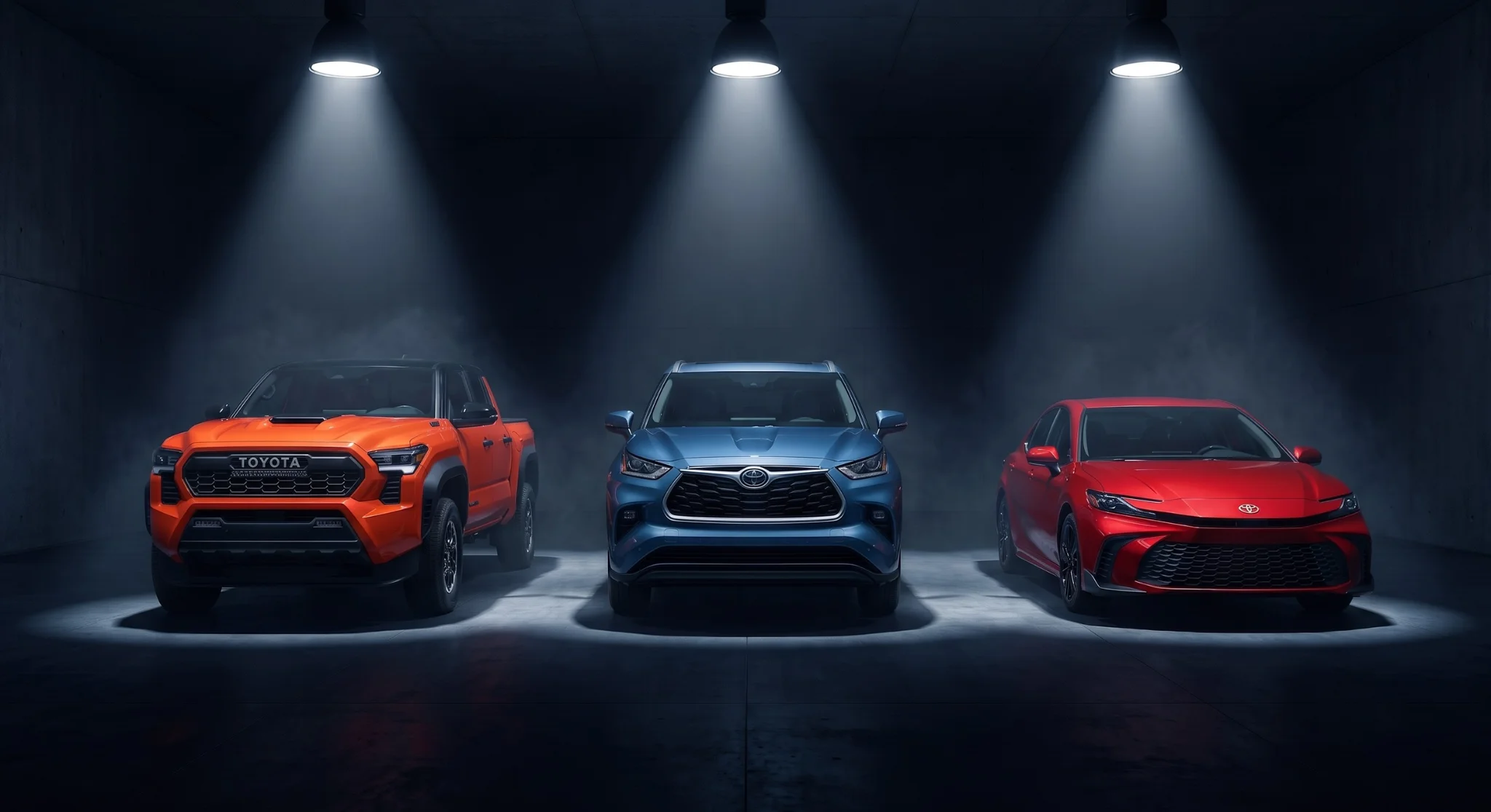
How Toyota’s Lineup Holds Value, Model by Model
Value retention runs deep across Toyota’s range — not just its trucks. Here’s how several core Toyota models are projected to hold value over five years, per Kelley Blue Book’s 2026 award data:
| Toyota Model | Segment | 5-Year Resale Value |
|---|---|---|
| Tacoma | Midsize Pickup | 63.0% |
| Tundra | Full-Size Pickup | 59.9% |
| 4Runner | Off-Road SUV | 58.0% |
| GR Supra | Sports Car | 56.0% |
| Sienna | Minivan | 54.3% |
| Prius | Hybrid/PHEV | 53.1% |
| Camry | Midsize Car | 51.9% |
| Grand Highlander | Midsize SUV | 50.9% |
Resale and residual value figures cited on this page are five-year projections from third-party sources, including Kelley Blue Book, and are not guarantees of future value. Actual resale and trade-in values vary by vehicle condition, mileage, market demand, location, and other factors. Dollar figures shown are illustrative examples only.
The Financial Math of Resale Value
The real cost of a vehicle isn’t the monthly payment or the sticker price — it’s the gap between what you pay today and what you recover when you sell. Here’s how that plays out over a five-year cycle on a $35,000 vehicle:
| Scenario | 5-Year Retention | Value After 5 Years | Equity Difference |
|---|---|---|---|
| Average vehicle | 44.7% | ~$15,645 | — |
| Toyota (brand avg) | 53% | ~$18,550 | +~$2,900 |
Retention figures: Kelley Blue Book, 2026 Best Resale Value Awards. Dollar values illustrative on a $35,000 example.
That’s nearly $3,000 in avoided depreciation — equity that functions as a built-in down payment on your next vehicle. When you weigh long-term cost this way, investing in a brand known for durability makes clear financial sense.
What Resale Value Actually Means for You
Equity You Keep
When a vehicle holds its value, the financial upside lands with the original owner. Slower depreciation means you keep more equity when it’s time to move into your next vehicle — equity that becomes a larger down payment and lower payments down the road.
Why the Used Market Pays More
The used market treats a pre-owned Toyota as a predictable, low-risk asset. Because these vehicles are engineered to run for hundreds of thousands of miles without catastrophic failures, second- and third-owners pay a premium for them, which props up trade-in values for the person who bought new. If you want to see that build quality in person, you can explore our new Toyota lineup or browse our pre-owned Toyota inventory online.
Why the Tacoma and Tundra Dominate Truck Value Retention
Built for Hard Use
Truck depreciation curves look nothing like those of passenger sedans. Midsize and full-size trucks are engineered for hard use — their frames, suspensions, and drivetrains are built to handle real workloads — which makes them prized on the used market.
The Numbers
Per Kelley Blue Book, Toyota’s two pickups don’t just lead their segments — they lead the entire industry, taking the top two overall spots for five-year retention:
| Truck | Segment | Overall Rank | 5-Year Resale Value |
|---|---|---|---|
| Toyota Tacoma | Midsize Pickup | No. 1 | 63.0% |
| Toyota Tundra | Full-Size Pickup | No. 2 | 59.9% |
That performance is driven by a loyal buyer base that understands these platforms last.
Local Capability
For drivers near the foothills above Hollywood and Glendale, a capable truck doubles as a gateway to the Santa Monica Mountains — whose eastern trailheads, including Griffith Park and Runyon Canyon, sit right at the edge of town. Whether hauling gear or towing a trailer, these trucks are built to shrug off heavy use, and used buyers know a pre-owned Tacoma or Tundra has plenty of working life left. That demand keeps prices remarkably stable.
How Engineering and Reliability Protect Used-Vehicle Equity
The Risk Calculation
Reliability turns into cash value through one mechanism: minimized risk for the next owner. When a used-car shopper eyes a vehicle with 80,000 miles on the clock, they’re mentally pricing the odds of an expensive component failure. With Toyota, that perceived risk is low.
Conservative Engineering
Toyota refines mechanical platforms over decades rather than swapping in unproven technology every few model years, so used buyers aren’t gambling on first-generation systems.
A Real Example: The 2026 RAV4
For the first time, the entire 2026 RAV4 lineup is hybrid. Here’s what every trim now shares:
- Powertrain — 2.5L Dynamic Force hybrid system (Toyota’s fifth-generation hybrid on HEV models)
- Transmission — Electronically controlled continuously variable transmission (eCVT)
- Fuel economy — EPA-estimated 47 city / 40 highway mpg on front-wheel-drive LE, SE, and XLE Premium trims
Because Toyota’s hybrid system has been refined across multiple generations, used shoppers don’t fear the battery or drivetrain concerns that can haunt less-established hybrids. The RAV4 rewards that confidence with strong resale performance: Kelley Blue Book named the 2026 RAV4 its Compact SUV Best Buy and expects it to hold its value well over the long run.
EPA-estimated fuel economy figures are for comparison purposes only. Your actual mileage will vary depending on driving conditions, how you drive and maintain your vehicle, battery age/condition, and other factors.
Key Factors That Drive Long-Term Value Retention
Engineering is the foundation, but several other factors shape where a specific vehicle lands on the depreciation curve:
- Segment demand — Trucks and body-on-frame SUVs hold value best because their utility doesn’t fade with age. Toyota’s strongest performers are the Tacoma, Tundra, and 4Runner.
- Trim selection — Broadly desirable mid-tier trims, such as the SE or Limited on the RAV4, appeal to the widest pool of future buyers.
- Factory safety technology — Standard advanced-safety suites keep a vehicle feeling current against newer models entering the market.
- Color and aesthetics — Mainstream, classic exterior colors retain value better than niche or polarizing palettes.
Understanding these variables helps you buy strategically the first time — choosing a configuration that will still be in demand years later.
How Southern California Climate Shapes Local Resale Value
Where a vehicle lives matters as much as how it’s driven. Southern California’s mild, dry climate is a genuine advantage for used-vehicle preservation.
The Corrosion Advantage
Unlike snowbelt regions where road salt eats away at frames, suspension components, and brake lines, vehicles here stay structurally clean underneath. That lack of undercarriage corrosion is a real selling point on the used market and helps local Toyotas appraise well.
The Sun Trade-Off
The local climate has one downside: intense sun. Over time, UV exposure can fade interior upholstery, dry out rubber seals, and oxidize paint. For drivers parking in open-air lots — common near destinations like Old Pasadena — a few habits protect the finish that appraisers scrutinize at trade-in time:
- Apply a quality paint sealant and reapply periodically
- Park in shaded or covered structures when possible
- Condition leather or SofTex surfaces to prevent sun-bleaching
The Hybrid Bonus
Stop-and-go traffic on local freeways actually favors hybrids. Regenerative braking captures energy that would otherwise be lost, which means less wear on brake pads and rotors. A hybrid driven in local traffic often shows lower mechanical wear than a comparable gas vehicle at the same mileage — another quiet boost to local resale appeal.
Everyday Maintenance Habits That Protect Resale Value
High mileage doesn’t automatically ruin resale value. A well-documented service history can make a higher-mileage Toyota genuinely attractive to budget-minded used buyers — a thick folder of maintenance receipts proves the previous owner didn’t defer critical care.
To protect your vehicle’s value, look beyond basic oil changes:
- Stay current on fluid services — Transmission fluid, coolant, and brake fluid flushes preserve the internal components of your powertrain.
- Replace filters on schedule — Cabin and engine air filters protect the HVAC system and support efficient combustion.
- Address small issues early — Worn sway-bar links or bushing noises, left alone, cause uneven tire wear that’s costly to reverse.
Keeping a vehicle in peak mechanical condition is simplest with factory-trained technicians using genuine OEM parts, which keeps everything to original factory specification.
This information is provided for general educational purposes only and does not constitute legal advice. Warranty coverage depends on the specific terms of your vehicle’s warranty agreement. Consult your owner’s manual or a qualified legal professional for guidance on your individual situation.
Questions Buyers Ask Most About Toyota Value Retention
Why do used Toyotas often cost more than other pre-owned vehicles?
Used Toyotas command a premium because buyers will pay more for proven reliability. Since these vehicles routinely reach high mileage without major engine or transmission failures, strong used-market demand keeps prices stable and prevents the steep drops seen in competing brands.
Does choosing a hybrid hurt my future resale value?
No — Toyota hybrids hold value exceptionally well. With fuel efficiency a top priority for local commuters, Toyota’s hybrids are in high demand on the used market, and their depreciation curves are highly competitive with gas-only models.
How does cosmetic condition affect a trade-in appraisal?
Significantly, because reconditioning costs come straight off the offer. Minor dings, paint scratches, interior stains, or torn upholstery can add up to hundreds of dollars in repairs, which lowers the initial trade-in figure.
Does resale value matter more if I trade in after three years or ten?
It matters most for short-term owners (three to five years), when depreciation is steepest and equity retention is critical. Long-term owners still benefit through lower overall repair costs and higher-than-average residual value even at high mileage.
Do aftermarket modifications like lift kits or custom exhausts improve resale value?
Generally no — and they often lower it. Most used buyers prefer factory-original configurations, and heavy modifications raise concerns about mechanical strain, voided warranties, or subpar installation.
Find Lasting Value at Toyota of Glendale
Maximizing the return on a vehicle investment starts with choosing a brand engineered to go the distance. By selecting a vehicle with industry-leading value retention, you protect your money and set up a favorable trade-in down the road. Whether you’re after an efficient hybrid commuter or a rugged, body-on-frame truck, the Toyota lineup delivers lasting value.
Explore what’s available and see how strong resale value fits into your next purchase.
Resale and residual value figures cited on this page are five-year projections from third-party sources, including Kelley Blue Book, and are not guarantees of future value. Actual resale and trade-in values vary by vehicle condition, mileage, market demand, location, and other factors. Dollar figures shown are illustrative examples only.
EPA-estimated fuel economy figures are for comparison purposes only. Your actual mileage will vary depending on driving conditions, how you drive and maintain your vehicle, battery age/condition, and other factors.
This information is provided for general educational purposes only and does not constitute legal advice. Warranty coverage depends on the specific terms of your vehicle’s warranty agreement. Consult your owner’s manual or a qualified legal professional for guidance on your individual situation.
This content is provided for general informational purposes only and does not constitute financial, tax, or legal advice. Individual circumstances vary; consult a qualified professional before making purchasing, financing, or trade-in decisions.
0 comment(s) so far on Why Toyotas Hold Their Value: Resale Value Explained