

What Oil Type and Capacity Does a Toyota Corolla (2010-2027) Require?
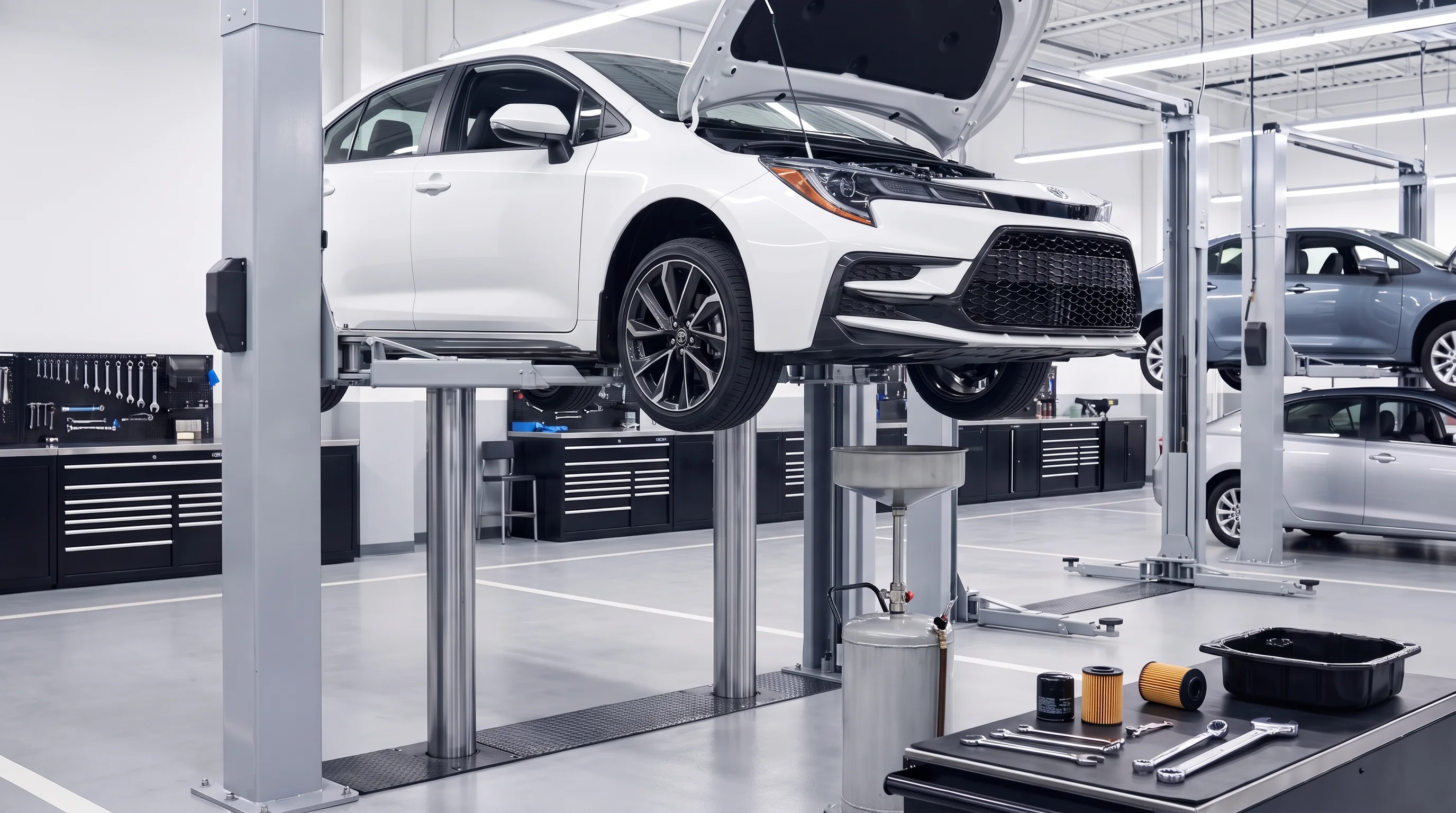
Toyota Corolla models from 2010 through 2027 take SAE 0W-20 motor oil in the 1.8-liter gas engine and ultra-low-viscosity SAE 0W-16 in the 2.0-liter Dynamic Force engine and the Corolla Hybrid. Engine oil capacity with a filter change runs from 4.0 to 4.9 quarts, depending on the engine. The 1.8-liter takes 4.4 quarts. The 2.0-liter takes 4.9 quarts.
This range covers three Corolla generations: the 10th, 11th, and 12th. Across all of them, matching the engine to its required viscosity and fluid volume is what keeps lubrication, heat dissipation, and durability where Toyota designed them. Earlier models with the 1.8-liter 2ZR-FE engine were engineered around SAE 0W-20. Then came the 2.0-liter Dynamic Force M20A-FKS engine and the 1.8-liter 2ZR-FXE hybrid. Both were built to tighter internal tolerances, and both call for SAE 0W-16 instead. Same nameplate, different fluid, and a different amount of it.
Toyota Corolla Oil Type and Capacity by Engine
Every figure below comes from Toyota’s published specifications. You can confirm the grade and capacity for your exact year and engine in Toyota’s owner’s manual lookup.
| Engine | Model Years | Oil Viscosity | Capacity with Filter |
|---|---|---|---|
| 1.8L 4-Cylinder Gas (2ZR-FE / 2ZR-FAE) | 2010–2022 | SAE 0W-20 | 4.4 quarts (4.2 L) |
| 2.4L 4-Cylinder Gas (2AZ-FE) | 2010–2013 | SAE 5W-20 or SAE 0W-20 | 4.0 quarts (3.8 L) |
| 2.0L 4-Cylinder Gas (M20A-FKS Dynamic Force) | 2020–2027 | SAE 0W-16 | 4.9 quarts (4.6 L) |
| 1.8L 4-Cylinder Hybrid (2ZR-FXE) | 2020–2027 | SAE 0W-16 | 4.4 quarts (4.2 L) |
The information in this article is general guidance and does not constitute a specific diagnostic or repair recommendation for any individual vehicle. Repair and maintenance decisions should be made in consultation with a certified technician based on the specific condition of your vehicle.
One note on the 2.4-liter. Toyota scheduled the 2AZ-FE on its non-synthetic maintenance schedule, not the synthetic one. Oil and filter service comes every 5,000 miles or six months. The synthetic-oil intervals described further down apply to the 0W-20 and 0W-16 engines.
How Many Quarts of Oil Does a 1.8L Toyota Corolla Engine Take?
A 1.8-liter 4-cylinder engine in a 2010 through 2022 Toyota Corolla takes 4.4 quarts of motor oil when the filter is replaced during a standard drain and fill.
That 4.4-quart figure accounts for the volume that stays behind in the oil galleries, the pump, and the replacement filter. A complete dry-engine fill is higher, but a routine service only needs the refill quantity. Pour in four full quart bottles and the engine sits close to half a quart short of the upper dipstick mark. That risks oil starvation under load. Going the other way is just as bad. Add five full quarts and the spinning crankshaft whips the oil into foam. Foam does not pump or lubricate the way liquid oil does.
Most 1.8-liter Corollas built from 2010 onward use a cartridge-style filter housing rather than a spin-on metal canister. Replacing the paper element and its rubber O-ring at every service keeps the bypass valve working. It also keeps abrasive particulate out of the 4.4 quarts of oil doing the work.
The 2.4-Liter Exception
The 2.4-liter 2AZ-FE engine, offered in the Corolla through the 2013 model year, is the exception in this lineup. It uses a different oil pan and filter setup, and it takes 4.0 quarts of SAE 5W-20 or SAE 0W-20. That is exactly why engine displacement gets confirmed before anyone pours anything in.
Why Does Toyota Recommend 0W-16 for the 2.0L Engine and Corolla Hybrid?
Toyota specifies ultra-low-viscosity SAE 0W-16 for the 2.0-liter Dynamic Force engine and the Corolla Hybrid. Lower internal friction improves thermal efficiency, supports instant lubrication when a hybrid engine restarts, and helps fuel economy.
The 2.0-liter Dynamic Force engine runs a 13:1 compression ratio with high-speed combustion and VVT-iE electric variable valve timing on the intake side. It reaches a maximum thermal efficiency of 40 percent. The Corolla Hybrid’s 1.8-liter engine uses the Atkinson cycle with a 13.0:1 compression ratio, a shorter intake stroke, and a longer expansion stroke than a conventional Otto-cycle engine. Thinner oil means less drag against piston skirts and camshaft journals in both engines. That reduced pumping resistance helps support the EPA-Estimated 35 MPG combined rating on the 2.0-liter gas Corolla and up to an EPA-Estimated 50 MPG combined on the Corolla Hybrid.
EPA-estimated fuel economy figures are for comparison purposes only. Your actual mileage will vary depending on driving conditions, how you drive and maintain your vehicle, battery age/condition, and other factors.
In a hybrid, the gasoline engine starts and stops repeatedly depending on throttle demand, battery charge, and vehicle speed. Across a stop-and-go commute, a hybrid engine may cycle on and off dozens of times. SAE 0W-16 flows to the upper cylinder head and camshaft bearings the instant the engine fires, which is what prevents metal-to-metal contact on all those restarts.
What If Your Corolla’s Oil Grade Isn’t Available?
Toyota allows a temporary substitute when the specified grade cannot be found, but it is genuinely temporary, and the two engines substitute in opposite directions.
If Your Corolla Calls for SAE 0W-20
SAE 5W-20 may be used temporarily. This applies to the 1.8-liter gas engine.
If Your Corolla Calls for SAE 0W-16
SAE 0W-20 may be used temporarily. This applies to the 2.0-liter Dynamic Force engine and the Corolla Hybrid.
Toyota’s owner’s manuals say the substitute must be replaced with the correct grade at the next oil change. Toyota’s warranty and maintenance guide is stricter still. If the certified grade was not used at the last service, replace the oil and filter at 5,000 miles or six months. Do not wait for the normal 10,000-mile mark.
How Do I Confirm Which Oil My Corolla Takes?
The fastest check is the engine oil filler cap, which is stamped with the factory-required grade — SAE 0W-16 or SAE 0W-20. Cross-reference it against the engine identification information for your vehicle if you want a second confirmation before service.
Filter part numbers are the place to be careful. Toyota lists several cartridge elements that look interchangeable and are not, and the correct one depends on your specific engine and model year. Rather than guess from a chart, give our service and parts team your year and engine and we will match the right filter to your Corolla. The drain plug is the same story. Toyota changed the Corolla’s drain plug part number partway through this range, so torque and sealing specs are not uniform across all model years.
How Often Should Corolla Oil Be Changed?
For a Corolla certified on 0W-20 or 0W-16, Toyota’s interval is 10,000 miles or 12 months, whichever comes first, as long as the certified grade is in the engine. Two situations shorten that interval.
| Situation | Oil and Filter Change Interval |
|---|---|
| Normal driving, certified 0W-20 or 0W-16 in the engine | 10,000 miles or 12 months |
| Mostly driven under Toyota’s special operating conditions | 5,000 miles or 6 months |
| A substitute grade was used at the last oil change | 5,000 miles or 6 months |
The information in this article is general guidance and does not constitute a specific diagnostic or repair recommendation for any individual vehicle. Repair and maintenance decisions should be made in consultation with a certified technician based on the specific condition of your vehicle.
What Counts as a Special Operating Condition?
Dirt or Dusty Roads
Driving on dirt roads or dusty roads.
Towing or Heavy Loading
Driving while towing, using a car-top carrier, or heavy vehicle loading.
Idling or Low-Speed Driving
Extensive idling and/or low-speed driving for a long distance.
If the majority of your driving does not fall into those categories, the additional services are not necessary. You can see how oil service fits alongside the rest of the maintenance timeline on our Toyota service schedule page.
Do Dealer Specials and Maintenance Coupons Lower Corolla Service Costs?
Dealership service coupons and manufacturer maintenance specials lower routine ownership costs while making sure the engine gets the factory-specified oil and a genuine OEM filter.
A dealer service coupon bundles four things into one transparent price: the correct volume of SAE 0W-16 or SAE 0W-20, a factory OEM filter, a new drain plug crush washer, and a multi-point inspection. That matters most on the 0W-16 engines. The specialized fluid and the cartridge filter O-rings are the parts most likely to become add-on line items elsewhere.
Every new Toyota also arrives with ToyotaCare, Toyota’s no-cost plan covering normal factory scheduled maintenance, including oil and filter changes, tire rotations, and multi-point inspections. Coverage terms have changed by model year, so check the current terms for your vehicle on our ToyotaCare page.
Common Questions About Toyota Corolla Oil Grades and Intervals
Can 5W-20 motor oil be used in a Corolla that calls for 0W-20?
Yes, temporarily. Toyota permits SAE 5W-20 when SAE 0W-20 is unavailable, but it has to be replaced with SAE 0W-20 at the next oil change. The thicker 5W rating increases cold-start drag, which slightly reduces fuel efficiency and slows initial oil circulation to the upper valvetrain on cold starts.
How often should full synthetic motor oil be changed in a Toyota Corolla?
Toyota’s interval is 10,000 miles or 12 months, whichever comes first, when the certified 0W-20 or 0W-16 grade is in the engine. Under Toyota’s special operating conditions — dirt or dusty roads, towing or heavy loading, or extensive idling and low-speed driving over long distances — that drops to 5,000 miles or six months.
What is the difference between cartridge and spin-on oil filters on the Corolla?
A cartridge system uses a reusable housing attached to the engine block that holds a replaceable paper element and rubber sealing rings. A spin-on filter is a self-contained metal canister with the element and an internal anti-drainback valve built in, and it threads directly onto the block.
Why does the oil level still need to be checked on the dipstick after a 4.4-quart fill?
Because the published capacity is a reference quantity. Toyota’s own manuals describe it that way. Drainage time, how level the vehicle is sitting, and filter absorption all shift the final level slightly. Warm the engine, shut it off, wait at least five minutes, and confirm the level sits between the low and full marks.
What happens if too much motor oil is added during an oil change?
The level in the pan rises far enough for the spinning crankshaft counterweights to strike the oil surface. That whips it into foam, introduces air into the lubrication system, reduces lubrication efficiency, raises operating temperatures, and can push out main crankshaft seals.
The information in this article is general guidance and does not constitute a specific diagnostic or repair recommendation for any individual vehicle. Repair and maintenance decisions should be made in consultation with a certified technician based on the specific condition of your vehicle.
Maintain Peak Engine Efficiency with Toyota Corolla Oil Service
Three things protect a Corolla’s reliability, fuel economy, and engine life: the factory oil grade, the correct refill capacity, and the right service interval. Sticking to all three is the single most effective thing an owner can do. A 1.8-liter takes 4.4 quarts of SAE 0W-20. A 2.0-liter Dynamic Force engine takes 4.9 quarts of SAE 0W-16. Either way, the right fluid in the right amount keeps the engine performing the way it did new.
Our service department uses factory-trained technicians, genuine OEM filters, and oil metering equipment calibrated for Toyota engines. If you would rather not sort out which grade and capacity apply to your model year, bring it to us at 1260 S Brand Blvd in Glendale and we will handle it.
Owners of other Toyota models can find the same breakdown for the Camry oil type and capacity and the RAV4 oil type and capacity.
Disclaimers
The information in this article is general guidance and does not constitute a specific diagnostic or repair recommendation for any individual vehicle. Repair and maintenance decisions should be made in consultation with a certified technician based on the specific condition of your vehicle.
EPA-estimated fuel economy figures are for comparison purposes only. Your actual mileage will vary depending on driving conditions, how you drive and maintain your vehicle, battery age/condition, and other factors.