

Toyota Camry Oil Type & Capacity: A By-Engine Guide (2012–2026)
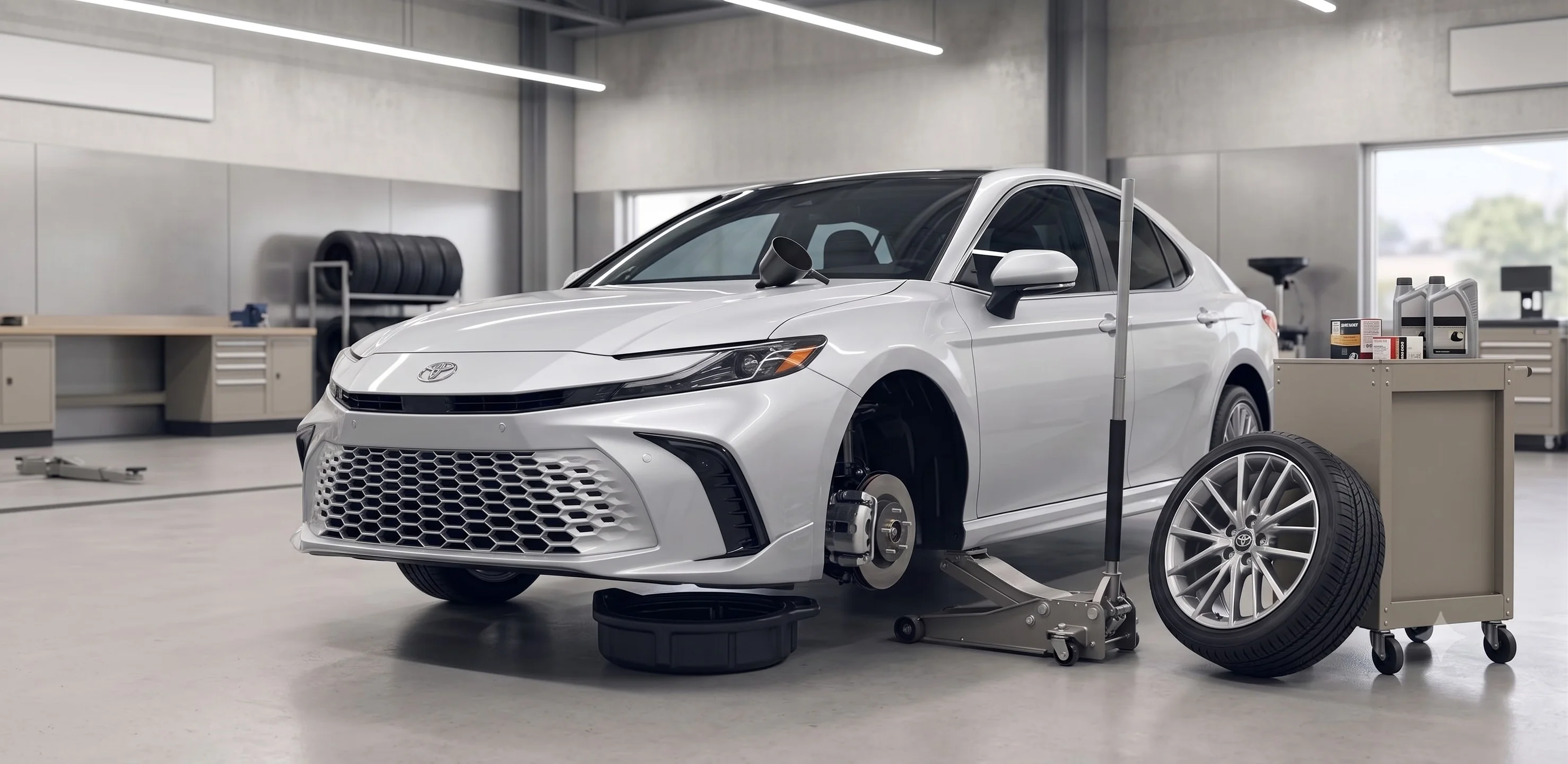
Knowing the right oil type and capacity for your Toyota Camry keeps your engine protected, your fuel economy where it should be, and your warranty intact. The correct specification depends on two things: your model year and your engine. Across the 2012–2026 range, the Camry has used three gasoline engines and a hybrid powertrain — each with its own viscosity and fill volume. This guide breaks it down engine by engine, then covers maintenance intervals, oil standards, and coolant care.
Quick note for 2025 and newer owners: Beginning with the 2025 redesign, the Camry became hybrid-only. If you’re shopping model years 2012–2024, you’ll find gas four-cylinder, hybrid, and V6 options; 2025 and later use a single 2.5L hybrid powertrain.
Toyota Camry Oil Type & Capacity by Engine
The table below shows the factory-recommended oil viscosity and capacity (with filter) for each Camry engine.
| Engine | Model Years | Recommended Oil | Capacity (w/ filter) |
|---|---|---|---|
| 2.5L 4-cyl (2AR-FE) | 2012–2017 | 0W-20 full synthetic | ~4.6 qt |
| 3.5L V6 (2GR-FE) | 2012–2017 | 0W-20 full synthetic | ~6.4 qt |
| 2.5L 4-cyl gas (A25A-FKS) | 2018–2023 | 0W-16 full synthetic | 4.8 qt |
| 2.5L 4-cyl gas (A25A-FKS) | 2024 | 0W-16 full synthetic | 4.5 qt |
| 2.5L hybrid (A25A-FXS) | 2018–2024 | 0W-16 full synthetic | 4.5 qt |
| 3.5L V6 (2GR-FKS) | 2018–2024 | 0W-20 full synthetic | 5.7 qt |
| 2.5L hybrid (A25A-FXS) | 2025–2026 | 0W-16 full synthetic | 4.5 qt |
Always confirm the final level on the dipstick after refilling — the amount added at a service can sit slightly below the total listed capacity because some oil remains in the engine’s passages. When in doubt, your owner’s manual and the oil filler cap list the exact grade for your specific vehicle.
Why Viscosity Matters — and Why It Changed Over the Years
Toyota moved toward progressively thinner oils across this range for a reason. Lower-viscosity grades reduce internal friction and flow instantly on cold starts, which supports both engine protection and EPA-estimated fuel economy. Here’s the short version of the progression:
- 2012–2017: Both the four-cylinder and V6 used 0W-20 full synthetic.
- 2018–2024: The Dynamic Force four-cylinder and the hybrid moved to ultra-low 0W-16; the V6 stayed on 0W-20.
- 2025–2026: The current hybrid continues on 0W-16 full synthetic for the U.S. market.
Using a heavier grade than specified over the long term can reduce EPA-estimated fuel economy, increase engine noise, and slow the response of variable valve timing. If your recommended grade is temporarily unavailable, the next grade up may be used as a one-time substitute — but return to the factory-specified grade at your next oil change.
EPA-estimated fuel economy figures are for comparison purposes only. Your actual mileage will vary depending on driving conditions, how you drive and maintain your vehicle, battery age/condition, and other factors.
Oil Standards: What API and ILSAC Mean for Your Camry
Beyond viscosity, Camry oil must meet specific industry certification standards. Look for these marks on the container:
- API SP (or SN) — the American Petroleum Institute “donut.” Certifies protection against high-temperature deposits, sludge, and timing-chain wear, and guards against low-speed pre-ignition (LSPI) in modern direct-injection engines.
- ILSAC GF-6 (GF-6A/GF-6B) — the “starburst” mark. The current standard; older GF-5 oils appear on earlier-model containers. GF-6 adds LSPI protection and improved fuel-economy retention. The ultra-low 0W-16 grade used in recent four-cylinder and hybrid Camry engines carries the GF-6B designation.
Choosing a certified oil keeps carbon deposits from choking oil passages and helps preserve the reliability the Camry is known for.
Toyota Camry Maintenance Intervals
Under normal driving conditions, here’s the maintenance rhythm for the Camry’s engine oil and cooling system:
| Service | Interval |
|---|---|
| Engine oil & filter (synthetic) | 10,000 miles or 12 months |
| Inspection & tire rotation | Every 5,000 miles or 6 months |
| Engine coolant — first replacement | 100,000 miles or 120 months |
| Engine coolant — thereafter | Every 50,000 miles or 60 months |
Your Camry’s maintenance reminder tracks the 5,000-mile inspection interval, while the oil itself is changed at 10,000 miles under normal conditions. Frequent short trips and stop-and-go driving count as more severe use — in those conditions, servicing more often helps prevent condensation and oil dilution in the crankcase.
Coolant and the Hybrid’s Two Cooling Systems
The Camry uses Toyota Super Long Life Coolant (SLLC), a pink long-life formula — don’t mix it with green conventional coolant. The intervals above apply to the engine cooling circuit.
Hybrid models have an important distinction worth knowing:
- Engine cooling circuit — the standard loop covered by the intervals in the table above.
- HV battery and inverter circuit — a completely separate loop that also requires periodic service and is often overlooked on general service menus.
Keeping both loops maintained protects against corrosion, water-pump wear, and inverter overheating. Our Toyota-trained service technicians know to check both — one reason it’s worth having hybrid service done by a shop that services the whole system, not just the engine loop.
Warranty Protection Starts With Oil Changes
Staying on schedule protects your factory coverage. For reference:
- Basic (bumper-to-bumper): 36 months / 36,000 miles
- Hybrid battery (2020 and newer): 10 years / 150,000 miles
- ToyotaCare complimentary maintenance: 2 years / 25,000 miles, covering scheduled oil changes, tire rotations, and inspections
Neglecting engine oil changes can jeopardize powertrain and hybrid-system coverage, so keeping records of on-schedule service is worth the effort. Coverage terms are sourced from Toyota’s official Warranty & Owner’s Manuals resources.
This information is provided for general educational purposes only and does not constitute legal advice. Warranty coverage depends on the specific terms of your vehicle’s warranty agreement. Consult your owner’s manual or a qualified legal professional for guidance on your individual situation.
Common Questions About Toyota Camry Oil
Can I use conventional oil in my Toyota Camry?
No. Recent Camry engines are designed for full synthetic oil in the specific grade for your engine — 0W-16 or 0W-20 depending on model year and powertrain. Conventional oil doesn’t provide the required cold-flow and high-temperature protection these precision engines need.
Does ToyotaCare cover my oil changes?
Yes. Every new Toyota includes ToyotaCare, which covers scheduled maintenance for 2 years or 25,000 miles, including oil changes, tire rotations, and multi-point inspections.
How do I know when my Camry is due for an oil change?
Your Camry’s maintenance reminder illuminates at the 5,000-mile inspection interval. The oil itself is changed every 10,000 miles under normal conditions; the 5,000-mile stop is for inspections and tire rotation.
What happens if I skip a coolant service?
Over time, coolant loses its corrosion inhibitors and turns acidic. That can corrode the radiator, degrade water-pump seals, and lead to overheating or expensive repairs — which is why the scheduled coolant service matters.
Schedule Your Toyota Camry Oil Change in Glendale
Whether you drive a 2012 four-cylinder or a 2026 hybrid, our Toyota-trained service technicians know the exact oil, filter, and fluid specifications for your engine. Serving Glendale, Los Angeles, Van Nuys, North Hollywood, and Hollywood, our service center uses genuine Toyota parts and factory-recommended lubricants to keep your Camry running its best.
Have questions about your specific model year or engine? Call our service team at 818-528-5070, and check our current service specials before your visit.
Disclaimers
The information in this article is general guidance and does not constitute a specific diagnostic or repair recommendation for any individual vehicle. Repair and maintenance decisions should be made in consultation with a certified technician based on the specific condition of your vehicle.
The information on this page is provided for general informational purposes only and is subject to change. Oil specifications, capacities, and maintenance intervals vary by model year, engine, and driving conditions — always consult your vehicle’s owner’s manual for the specifications that apply to your Camry. Please contact our service department to confirm details for your specific vehicle.