

Toyota Tacoma Oil Type & Capacity: A By-Engine Guide (2010–2026)
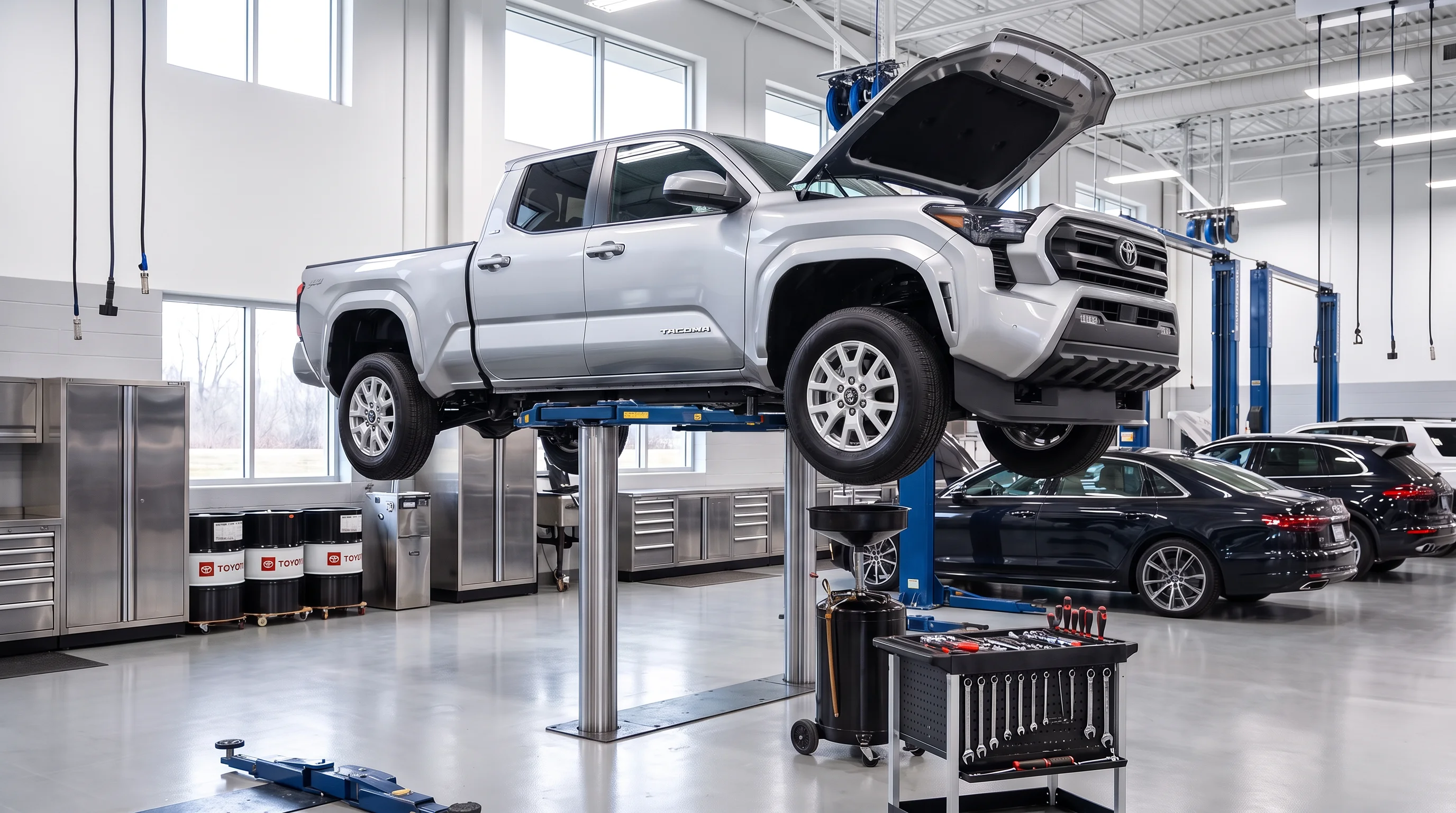
Running the right oil in your Toyota Tacoma protects the engine and preserves your factory coverage. The correct specification comes down to two things: your model year and your engine. Across the 2010–2026 range the Tacoma has used four gasoline engines and a hybrid powertrain. Each has its own viscosity and fill volume. This guide works through them engine by engine, then covers maintenance intervals, oil standards, and warranty protection.
Quick note on generations: trucks from 2010 through 2015 use the second-generation 2.7L four-cylinder or 4.0L V6. The 2016–2023 third generation pairs the 2.7L with a 3.5L V6. From 2024 forward, the fourth-generation Tacoma runs a 2.4L turbocharged four, offered either as the standard i-FORCE engine or as the i-FORCE MAX hybrid.
Toyota Tacoma Oil Type & Capacity by Engine
The table below shows the recommended oil viscosity and approximate capacity with a filter change for each Tacoma engine in this range.
| Engine | Model Years | Recommended Oil | Capacity (w/ filter) |
|---|---|---|---|
| 2.7L 4-cyl (2TR-FE) | 2010–2015 | Check your oil filler cap — the specification changed during these years | ~5.8 qt |
| 4.0L V6 (1GR-FE) | 2010–2015 | 5W-30 | ~5.5 qt |
| 2.7L 4-cyl (2TR-FE) | 2016–2023 | 0W-20 full synthetic | ~5.8 qt |
| 3.5L V6 (2GR-FKS) | 2016–2023 | 0W-20 full synthetic | Call our service team to confirm for your model year |
| 2.4L Turbo i-FORCE and i-FORCE MAX (T24A-FTS) | 2024–2026 | 0W-20 full synthetic | ~5.9 qt |
Treat these capacities as a starting point rather than a target. Always confirm the final level on the dipstick after refilling. Some oil stays behind in the engine’s passages, so the amount a service actually takes can sit slightly below the total listed capacity. Your owner’s manual and the oil filler cap are the authoritative sources for your specific truck.
The information in this article is general guidance and does not constitute a specific diagnostic or repair recommendation for any individual vehicle. Repair and maintenance decisions should be made in consultation with a certified technician based on the specific condition of your vehicle.
Why the Specification Changed Across Generations
Toyota moved toward progressively thinner oils over this span, and the reasoning is consistent across the lineup. Lower-viscosity grades cut internal friction. They also reach the top of the engine almost immediately on a cold start, which supports both engine protection and EPA-estimated fuel economy.
The older 4.0L V6 was engineered around 5W-30 and stays there. The 2.7L four-cylinder is the one that moved. Toyota transitioned it to 0W-20 full synthetic partway through the second generation. That is why a 2010–2015 truck needs to be checked individually rather than assumed. The oil filler cap on your engine carries the grade Toyota specified for that truck, and it settles the question in about three seconds. The current 2.4L turbocharged engine runs 0W-20 in both the i-FORCE and i-FORCE MAX configurations. Fast oil delivery to the turbocharger bearings on startup matters more here than it ever did on the naturally aspirated engines.
Running a heavier grade than specified increases internal drag. Over the long term that can reduce EPA-estimated fuel economy, raise engine noise, and slow the response of variable valve timing. If your grade is temporarily unavailable, the next grade up works as a one-time substitute — but return to the specified grade at your next service.
EPA-estimated fuel economy figures are for comparison purposes only. Your actual mileage will vary depending on driving conditions, how you drive and maintain your vehicle, battery age/condition, and other factors.
Oil Standards: What API and ILSAC Mean for Your Tacoma
Viscosity is only half the specification. The oil also has to meet industry certification standards set through the American Petroleum Institute’s Engine Oil Licensing and Certification System. Both marks appear on the container:
- API SP (or SN on older stock) — the American Petroleum Institute “donut.” Certifies protection against high-temperature deposits, sludge, and timing-chain wear, and guards against low-speed pre-ignition in modern direct-injection engines.
- ILSAC GF-6 — the “starburst” mark, and the current standard. Older containers carry GF-5. GF-6 adds low-speed pre-ignition protection.
These standards matter most on the turbocharged 2.4L. Oil runs hotter there, and works harder than it does in the older naturally aspirated engines. You can order genuine Toyota filters through our parts department if you service your own truck.
Can You Switch Back to Conventional Oil?
There is a long-standing worry that switching from synthetic back to conventional oil causes seals to shrink or leak. It is a myth. Modern synthetic and conventional oils use compatible base stocks and additive packages. On an older engine specified for a heavier grade, alternating between conventional, synthetic blend, and full synthetic causes no mechanical harm.
The real constraint is availability, not chemistry. The 0W-20 grade that current Tacoma engines require is only produced as a full synthetic. Refiners can’t hit those cold-flow and thermal-stability targets with a conventional formulation. So for any truck specified for 0W-20, switching back isn’t a decision you get to make. Substituting a heavier conventional oil like 10W-30 into an engine built for 0W-20 increases internal friction. It also slows oil delivery to the turbocharger and variable valve timing hardware.
For older Tacomas where conventional oil remains an option, full synthetic still holds up better against thermal breakdown under sustained load.
Toyota Tacoma Maintenance Intervals
| Service | Interval |
|---|---|
| Engine oil & filter (full synthetic) | 10,000 miles or 12 months |
| Inspection & tire rotation | Every 5,000 miles or 6 months |
These are the intervals Toyota publishes for trucks running full synthetic under normal conditions. Confirm the exact schedule for your truck with Toyota’s maintenance schedule lookup. Your Tacoma’s maintenance reminder tracks the 5,000-mile inspection interval, while the oil itself goes 10,000 miles under normal conditions. Trucks that tow, haul payload regularly, idle in traffic, or run short trips fall under severe-use conditions and benefit from more frequent service. If the reminder stays lit after a service, here’s how to reset your maintenance light. You can also review the full Toyota service schedule for everything else due at each milestone.
Warranty Protection Starts With Oil Changes
Staying on schedule protects your factory coverage. Here is what a new 2026 Tacoma carries:
| Coverage | Term |
|---|---|
| Basic (bumper-to-bumper) | 3 years / 36,000 miles |
| Powertrain | 5 years / 60,000 miles |
| Roadside assistance | 2 years / unlimited miles |
| ToyotaCare complimentary maintenance | 2 years / 25,000 miles |
ToyotaCare covers the scheduled oil changes, tire rotations, and inspections above for the first two years. Terms shown are for the 2026 model year and differ on earlier and later trucks.
Using an aftermarket oil filter does not automatically void your warranty under federal law, provided the filter meets Toyota’s filtration and flow specifications. But an aftermarket filter can fail, collapsing internally or leaking at the mounting seal. If that failure damages the engine, the resulting repair isn’t covered. Keeping records of on-schedule service is worth the effort. Coverage terms come from Toyota’s official Warranty & Owner’s Manuals resources.
This information is provided for general educational purposes only and does not constitute legal advice. Warranty coverage depends on the specific terms of your vehicle’s warranty agreement. Consult your owner’s manual or a qualified legal professional for guidance on your individual situation.
Common Questions About Toyota Tacoma Oil
What happens if you overfill the engine oil in a Toyota Tacoma?
Filling above the maximum dipstick mark submerges the rotating crankshaft in the oil pool. That churning aerates the oil, creating air bubbles that reduce oil pressure and degrade lubrication. It can also force oil past valve guide seals and main crankshaft seals, which shows up as blue exhaust smoke, fouled spark plugs, and premature seal leaks. If your truck is overfilled, the excess should be drained promptly.
How do you check the oil level on a Toyota Tacoma?
Park on level ground and bring the engine to normal operating temperature, then shut it off and wait about five minutes so oil in the cylinder head drains back into the pan. Pull the dipstick, wipe it clean with a lint-free towel, and reinsert it fully. Pull it a second time and read the film against the upper and lower marks. The level should sit between them — never below the low mark, and never above the full mark.
How often should you change the oil filter on a Toyota Tacoma?
Toyota specifies replacing the filter at every oil change, not every other one. Reusing a filter lets trapped contaminants, metal particles, and carbon deposits recirculate through fresh oil, which defeats much of the point of the service.
Does the hybrid i-FORCE MAX need different oil than the standard i-FORCE?
No. Both the standard 2.4L turbocharged i-FORCE engine and the i-FORCE MAX hybrid use the same 0W-20 full synthetic specification. The hybrid system adds an electric motor to the same turbocharged engine, so the engine oil requirement doesn’t change.
Schedule Your Toyota Tacoma Oil Change in Glendale
Whether you drive a 2010 four-cylinder work truck or a 2026 i-FORCE MAX, our Toyota-trained service technicians know the right oil, filter, and fluid for your engine. That includes the model years where the specification changed mid-generation. Serving Glendale, Los Angeles, Van Nuys, North Hollywood, Hollywood, and Pasadena, our service center uses genuine Toyota parts and factory-recommended lubricants.
Have questions about your specific model year or engine? Call our service team at 818-528-5070 and check our current service specials before your visit. Driving a different Toyota? We have the same by-engine breakdown for Camry oil type and capacity and RAV4 oil type and capacity.
Disclaimers
The information in this article is general guidance and does not constitute a specific diagnostic or repair recommendation for any individual vehicle. Repair and maintenance decisions should be made in consultation with a certified technician based on the specific condition of your vehicle.
EPA-estimated fuel economy figures are for comparison purposes only. Your actual mileage will vary depending on driving conditions, how you drive and maintain your vehicle, battery age/condition, and other factors.
This information is provided for general educational purposes only and does not constitute legal advice. Warranty coverage depends on the specific terms of your vehicle’s warranty agreement. Consult your owner’s manual or a qualified legal professional for guidance on your individual situation.
The information on this page is provided for general informational purposes only and is subject to change. Oil specifications, capacities, and maintenance intervals vary by model year, engine, and driving conditions — always consult your vehicle’s owner’s manual for the specifications that apply to your Tacoma. Please contact our service department to confirm details for your specific vehicle.