

2026 Toyota RAV4 Plug-in Hybrid vs. RAV4 Hybrid: Which Electrified SUV Fits Your LA Commute?
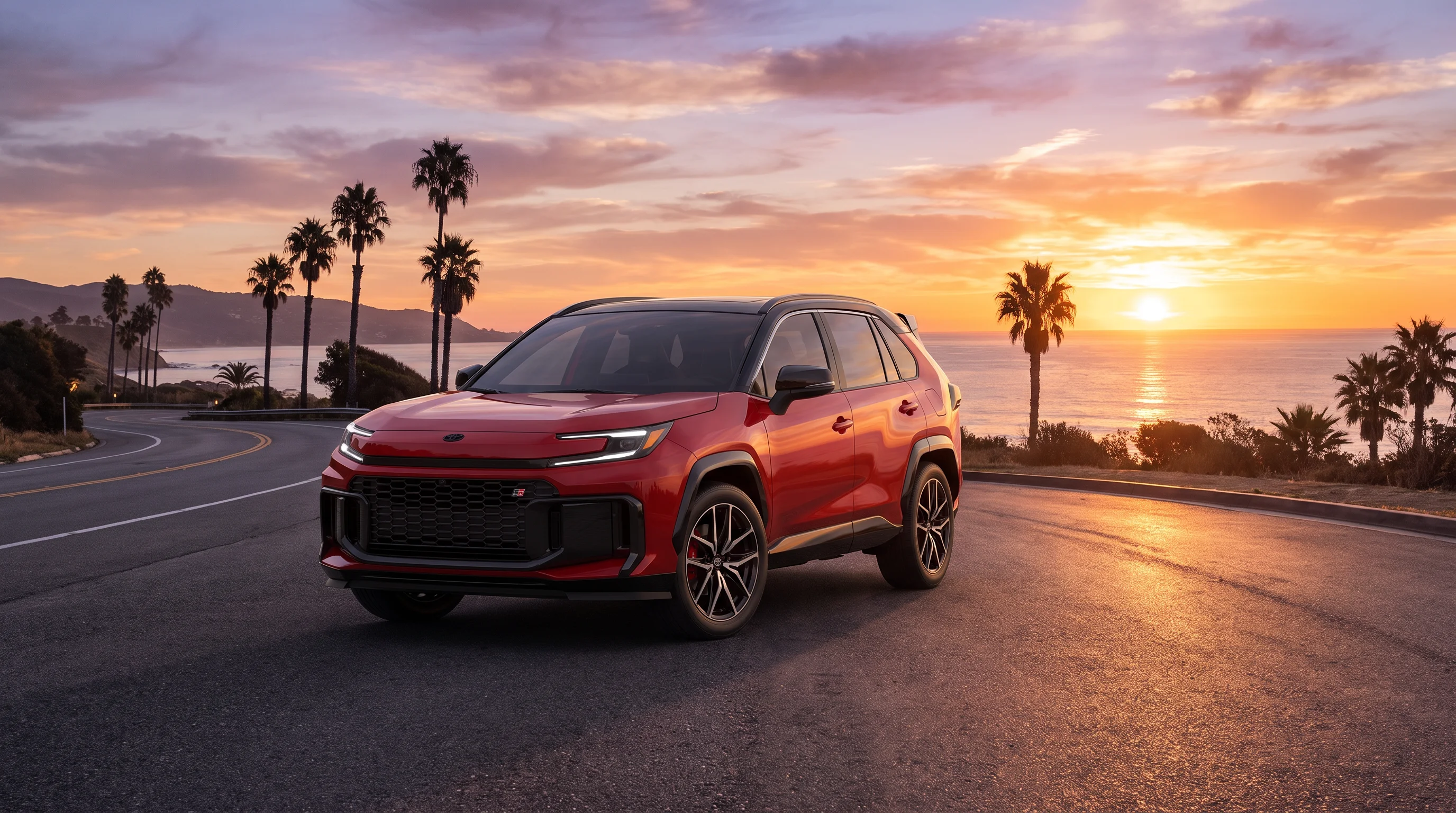
Every 2026 Toyota RAV4 is electrified. Toyota retired the gas-only engine for the sixth-generation redesign, so the question is no longer whether to go hybrid. It is whether to plug in. The RAV4 Hybrid recharges itself and starts at $33,350 TSRP. The RAV4 Plug-in Hybrid adds 324 horsepower, standard all-wheel drive, and the ability to drive on electricity alone, starting at $42,950 TSRP. Which one fits you depends less on the spec sheet than on where you park at night and how far you drive before you get back there.
How the Two 2026 RAV4 Powertrains Differ
Both powertrains share the same 2.5-liter four-cylinder engine and a planetary-type continuously variable transmission. Both seat five across two rows. The difference is the battery and what it allows the vehicle to do.
2026 RAV4 Hybrid
The RAV4 Hybrid captures energy while braking and coasting, stores it in a small battery, and uses it to supplement the gas engine. It never plugs in. Front-wheel drive is standard on the LE, SE, and XLE Premium grades with electronic on-demand all-wheel drive available; Woodland, XSE, and Limited come with all-wheel drive standard. Output is 226 horsepower with front-wheel drive and 236 horsepower with all-wheel drive, per Toyota’s published 2026 RAV4 product information.
2026 RAV4 Plug-in Hybrid
The RAV4 Plug-in Hybrid carries a 22.7-kWh lithium-ion battery, large enough to run the vehicle on electricity alone for a typical day of local driving. All four plug-in grades come with all-wheel drive standard, and total system output climbs to 324 horsepower, per Toyota’s published RAV4 Plug-in Hybrid specifications. Once the battery is depleted, the Plug-in Hybrid simply operates as a gas-electric hybrid.
Seven Grades, Two Price Ladders
The 2026 lineup spans seven grades across three design themes, offered in ten powertrain-and-grade combinations: six Hybrid and four Plug-in Hybrid. Grade pricing below reflects Toyota’s announced 2026 RAV4 pricing, with delivery, processing, and handling included.
| Powertrain | Grade | Drivetrain | TSRP* |
|---|---|---|---|
| Hybrid | LE | FWD | $33,350* |
| Hybrid | SE | FWD | $36,150* |
| Hybrid | XLE Premium | FWD | $37,550* |
| Hybrid | Woodland | AWD | $41,350* |
| Hybrid | XSE | AWD | $42,750* |
| Hybrid | Limited | AWD | $44,750* |
| Plug-in Hybrid | SE | AWD | $42,950* |
| Plug-in Hybrid | Woodland | AWD | $46,750* |
| Plug-in Hybrid | XSE | AWD | $48,650* |
| Plug-in Hybrid | GR SPORT | AWD | $49,950* |
*Total Suggested Retail Price (TSRP) for new vehicles includes manufacturer and distributor options and delivery, processing, and handling fees, which are subject to change at any time. TSRP excludes taxes, title, license, dealer-installed options, accessories, fees and charges. TSRP is not the dealer advertised price. Dealer price will vary. The dealer sets the final price.
What the Price Gap Actually Looks Like
Comparing entry points, the Hybrid LE with front-wheel drive costs $9,600 less than the base Plug-in Hybrid SE and $16,600 less than the range-topping GR SPORT. Some of that gap reflects equipment rather than the battery. Every Plug-in Hybrid grade includes all-wheel drive as standard, while the Hybrid LE, SE, and XLE Premium are front-wheel drive with all-wheel drive available, and Woodland, XSE, and Limited include it. If you want a like-for-like all-wheel-drive comparison, ask us for current all-wheel-drive pricing on the grade you are considering.
For a grade-by-grade breakdown of equipment, see our 2026 RAV4 trims and pricing page. You can also review current new-vehicle specials or apply for financing before you visit.
Fuel Economy, Electric Driving, and Charging Access
This is the section that decides the question for most shoppers.
How Far the Hybrid Goes on a Gallon
The RAV4 Hybrid is the most efficient RAV4 you never have to plug in. Front-wheel-drive LE, SE, and XLE Premium grades carry an EPA-estimated 47 city / 40 highway / 43 combined MPG. Adding all-wheel drive to the LE or SE brings that to an EPA-estimated 46 city / 39 highway / 42 combined MPG. Every grade runs on regular unleaded, and there is no charging equipment to buy, install, or plan around. Current EPA-estimated ratings for every configuration are published at fueleconomy.gov.
What Plugging In Adds
The RAV4 Plug-in Hybrid answers a different question. With a full battery, it runs on electricity alone until the battery is depleted. Toyota rates the SE highest in the plug-in lineup at up to an EPA-estimated 54 miles of all-electric range. The XSE is rated just below the SE, the Woodland at an EPA-estimated 49 miles, and the GR SPORT at an EPA-estimated 48 miles. For a Glendale driver whose day is a commute into Los Angeles, a school run, and errands, that can mean most weeks pass without buying fuel. Once the battery runs down, the vehicle continues as an efficient gas-electric hybrid, rated at an EPA-estimated 40 combined MPG on the SE and XSE, 37 on the Woodland, and 36 on the GR SPORT, so a long drive is never a problem. Confirm the EPA-estimated all-electric range and MPGe rating on the window sticker of the specific vehicle you are considering, or on Toyota’s RAV4 Plug-in Hybrid page.
The Deciding Variable Is Charging Access
Every Plug-in Hybrid grade comes with a dual-voltage charging cable, so a standard 120-volt household outlet works for slow overnight replenishment. But the plug-in only earns its price premium if you can reliably reach a full battery most mornings. In practice, that means a 240-volt Level 2 setup or equivalent workplace charging. The SE and GR SPORT use a 7-kW onboard charger with a J1772 port and can go from 10% to 80% in roughly four hours on Level 2. The Woodland and XSE step up to an 11-kW onboard charger and add a CCS1 port with DC fast-charging capability, taking 10% to 80% in approximately 30 minutes under ideal conditions.
If you have a garage outlet and a short daily round trip, the Plug-in Hybrid does something the Hybrid cannot. If you street park, or if your driving is unpredictable and long, the Hybrid delivers most of the fuel-economy benefit with none of the logistics.
EPA-estimated fuel economy figures are for comparison purposes only. Your actual mileage will vary depending on driving conditions, how you drive and maintain your vehicle, battery age/condition, and other factors.
Charging times provided are estimates only and will vary depending on charger output, weather conditions, battery condition, and other factors. Use for comparison purposes only.
2026 RAV4 Plug-in Hybrid range and efficiency ratings are published by Toyota as projected figures determined using preliminary EPA testing procedures. Specifications, ratings, and availability are subject to change. All figures are sourced from Toyota’s published 2026 RAV4 product information; confirm the window sticker of the specific vehicle before purchase.
Cargo and Passenger Space
The Cabin Is Identical
Both RAV4 powertrains seat five in the same cabin, and Toyota lists the same legroom for both.
| Passenger Dimension | Front Row | Second Row |
|---|---|---|
| Headroom (with moonroof) | 37.9 in | 39.5 in |
| Legroom | 41.0 in | 37.8 in |
Where They Diverge: Behind the Second Row
The RAV4 Hybrid offers 37.8 cubic feet of cargo volume behind the second row, expanding to 70.4 cubic feet with the 60/40 split rear seatbacks folded. The Plug-in Hybrid gives up some of that floor space to its larger traction battery, so its cargo figures are lower in both configurations. Check the specification sheet for the exact plug-in grade you are considering, or ask our team to pull it for you.
For groceries, strollers, and luggage, both are competitive in the compact SUV class. For bulky, repeated hauling, the Hybrid has the edge.
Performance, Capability, and Everyday Driving
Power and Feel
The Plug-in Hybrid’s 324 horsepower is the headline number in the RAV4 lineup, and it makes the plug-in noticeably quicker off the line than the 226 or 236 horsepower Hybrid. That output comes with the added mass of a much larger battery pack. The two share the same TNGA-K platform, but they do not carry the same weight or the same suspension tuning, and the GR SPORT adds its own GR-developed dampers, springs, and steering calibration. They do not feel the same through a corner.
Both powertrains have more than enough on-ramp authority. That holds on the Foothill Freeway corridor between Glendale and Pasadena, and on the canyon routes north of La Cañada Flintridge. The plug-in simply has more of it in reserve.
Towing
On the RAV4 Hybrid, towing capacity is set by grade rather than by drivetrain. Toyota rates the LE at 1,750 pounds and the other Hybrid grades at up to 3,500 pounds when properly equipped. The Plug-in Hybrid is rated at up to 3,500 pounds when properly equipped. Toyota does not publish a towing rating for the GR SPORT, which is worth knowing before you choose the lineup’s most powerful grade for trailer duty.
Specifications Side by Side
| Specification | 2026 RAV4 Hybrid | 2026 RAV4 Plug-in Hybrid |
|---|---|---|
| Net combined horsepower | 226 hp (FWD) / 236 hp (AWD) | 324 hp |
| Engine | 2.5L four-cylinder | 2.5L four-cylinder |
| Transmission | Planetary-type CVT | Planetary-type CVT |
| Drivetrain | FWD standard on LE, SE, XLE Premium with AWD available; AWD standard on Woodland, XSE, Limited | AWD standard on all four grades |
| EPA-estimated fuel economy | 47/40/43 MPG (LE, SE, XLE Premium FWD); 46/39/42 MPG (LE, SE AWD) | Gas-only combined: 40 MPG (SE, XSE); 37 MPG (Woodland); 36 MPG (GR SPORT) |
| EPA-estimated all-electric range | Not applicable — recharges itself and never plugs in | Up to 54 miles (SE); XSE just below; 49 miles (Woodland); 48 miles (GR SPORT) |
| Traction battery | Self-charging hybrid battery | 22.7-kWh lithium-ion |
| Onboard charger / port | Not applicable — no charge port | 11 kW with CCS1 and DC fast charging (Woodland, XSE); 7 kW with J1772 (SE, GR SPORT) |
| Cargo behind second row | 37.8 cu ft | Lower than Hybrid — see grade specification sheet |
| Maximum cargo volume | 70.4 cu ft | Lower than Hybrid — see grade specification sheet |
| Maximum towing | 1,750 lbs (LE); up to 3,500 lbs on other grades, properly equipped | Up to 3,500 lbs, properly equipped; GR SPORT not rated |
| Seating | 5 | 5 |
| Fuel | Regular unleaded | Regular unleaded |
Maximum towing and payload capacity figures are based on properly equipped vehicles and vary by configuration. Do not exceed any weight rating. See your owner’s manual and the vehicle’s door-jamb label for specific capacities.
Technology and Safety Are the Same on Both
There is no technology or safety trade-off between the two powertrains, which simplifies the decision considerably.
Cabin Technology
Every 2026 RAV4 includes a standard 12.3-inch digital gauge cluster and a standard 10.5-inch Toyota Audio Multimedia touchscreen, with a 12.9-inch touchscreen available on upper grades. The system runs on the Arene software platform. Connected services trials include Drive Connect, Remote Connect, and Wi-Fi Connect, with coverage varying by grade.
Toyota Safety Sense 4.0
The 2026 RAV4 debuts Toyota Safety Sense 4.0, standard on every grade of both powertrains. The suite includes the Pre-Collision System, Lane Departure Alert with Steering Assist, Lane Tracing Assist, Dynamic Radar Cruise Control, Road Sign Assist, and Automatic High Beams. It also adds Proactive Driving Assist, which applies gentle braking and steering support in ordinary driving situations rather than waiting for an emergency. Blind Spot Monitor and Rear Cross-Traffic Alert are now standard across the entire lineup rather than reserved for upper grades. Full system descriptions are published on Toyota’s RAV4 features page.
Driver-assistance and advanced safety systems are supplemental aids and are not substitutes for safe and attentive driving. Availability, operation, and effectiveness vary by trim and equipment and depend on factors including road, weather, traffic, and vehicle condition. Always keep your hands on the wheel and your eyes on the road. See your owner’s manual for system limitations and details.
So Which 2026 RAV4 Should You Choose?
Choose the RAV4 Hybrid if…
You cannot charge at home. You want the lowest entry price. You regularly fill the cargo area. Or you simply want the most efficient RAV4 that asks nothing of you beyond a gas station. At $33,350 TSRP with an EPA-estimated 43 MPG combined, it is the volume choice for good reasons.
Choose the RAV4 Plug-in Hybrid if…
You have reliable overnight charging and a daily round trip that fits inside its EPA-estimated electric range. In that scenario you get 324 horsepower, standard all-wheel drive, and the ability to do most of your driving without gasoline, while keeping a full hybrid drivetrain for road trips. The $9,600 gap between the Hybrid LE and the Plug-in Hybrid SE is real, and it is recovered through fuel savings only if the battery actually gets used.
Neither answer is wrong. They are answers to different questions.
Frequently Asked Questions
Is the 2026 RAV4 Plug-in Hybrid worth the extra cost over the RAV4 Hybrid?
It depends almost entirely on charging access. The Plug-in Hybrid SE starts at $42,950 TSRP against $33,350 TSRP for the Hybrid LE, a $9,600 difference. If you can charge overnight and your daily driving fits inside the EPA-estimated electric range, the plug-in lets you drive on electricity most days while keeping 324 horsepower and standard all-wheel drive. If you cannot charge reliably, the Hybrid delivers an EPA-estimated 43 MPG combined with no infrastructure required.
How far can the 2026 RAV4 Plug-in Hybrid go on electricity alone?
EPA-estimated all-electric range varies by grade, since wheel size and aerodynamic tuning affect efficiency. Toyota rates the SE highest at up to an EPA-estimated 54 miles, with the XSE just below it, the Woodland at an EPA-estimated 49 miles, and the GR SPORT at an EPA-estimated 48 miles. Check the window sticker of the specific vehicle for its EPA-estimated all-electric range rating. Once the battery is depleted, the vehicle continues as a gas-electric hybrid, so electric range is a daily-driving benefit rather than a limit on how far you can travel.
Which 2026 RAV4 offers more cargo space?
The RAV4 Hybrid. It provides 37.8 cubic feet behind the second row and 70.4 cubic feet with the rear seats folded. The Plug-in Hybrid offers less in both configurations because its larger traction battery occupies floor space. Check the specification sheet for the plug-in grade you are considering.
How do towing capacities compare between the two RAV4 powertrains?
On the RAV4 Hybrid, capacity is set by grade rather than drivetrain: Toyota rates the LE at 1,750 pounds and the other Hybrid grades at up to 3,500 pounds when properly equipped. The RAV4 Plug-in Hybrid is rated at up to 3,500 pounds when properly equipped. Toyota does not publish a towing rating for the GR SPORT.
What safety systems come standard on the 2026 RAV4?
Toyota Safety Sense 4.0 is standard on every grade of both powertrains. It includes the Pre-Collision System, Lane Departure Alert with Steering Assist, Lane Tracing Assist, Dynamic Radar Cruise Control, Road Sign Assist, Automatic High Beams, and Proactive Driving Assist. Blind Spot Monitor and Rear Cross-Traffic Alert are standard across the lineup.
See Both in Person at Toyota of Glendale
Specifications settle some of this, but a test drive settles the rest, especially the difference in how the two powertrains deliver power. Our team at 1260 S Brand Blvd in Glendale can walk you through both and check which grades are on the ground. We can also help you work out whether a home charging setup makes sense for your commute.