

2026 Toyota RAV4 MPG & Fuel Economy Guide
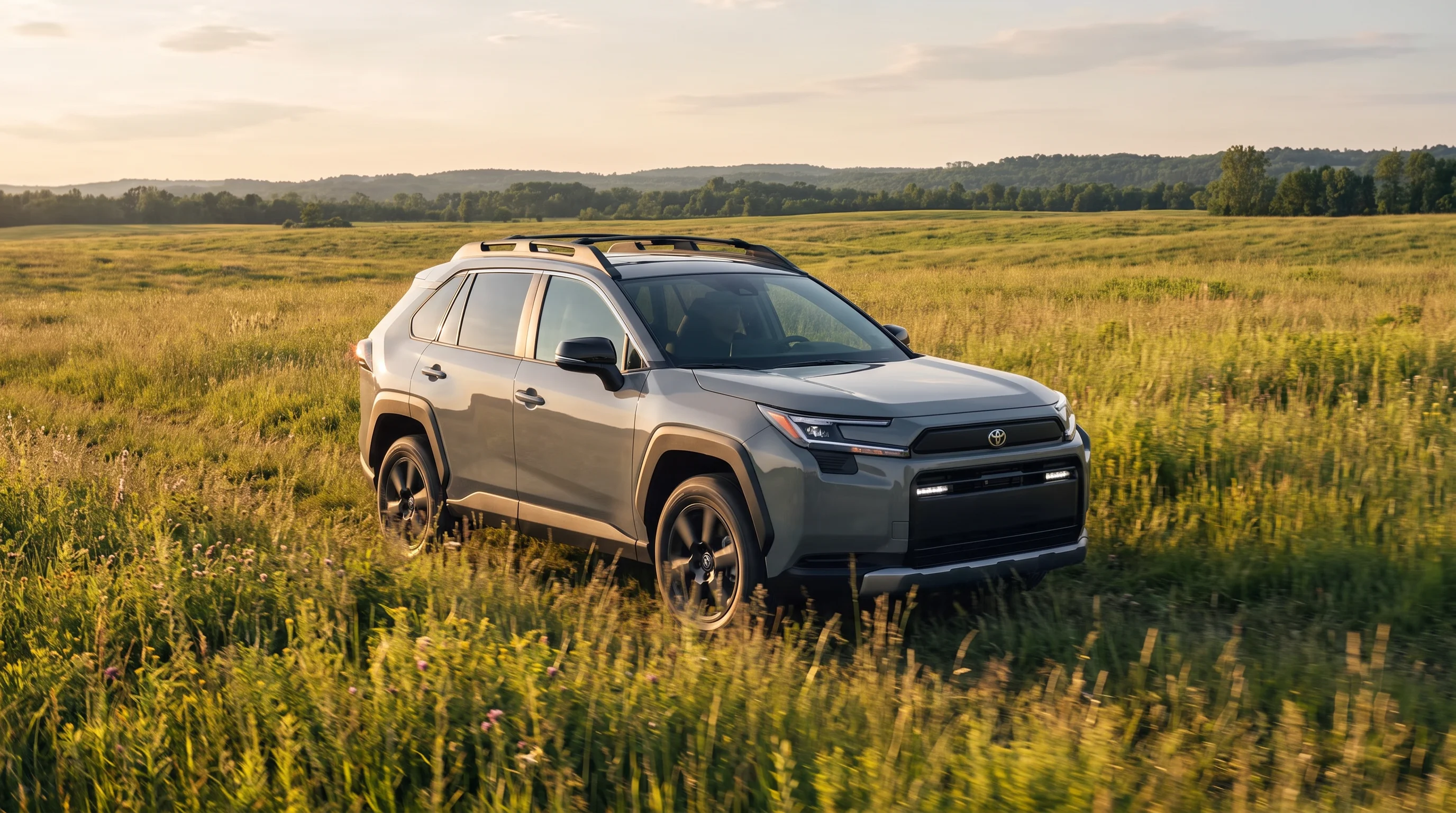
The 2026 Toyota RAV4 is hybrid-only for the first time in the model’s history, and fuel economy is the headline. Front-wheel-drive LE, SE, and XLE Premium models lead the lineup at an EPA-estimated 47 mpg city, 40 mpg highway, and 43 mpg combined. Add all-wheel drive and the LE and SE rate an EPA-estimated 46 city, 39 highway, and 42 combined. This guide breaks down what every 2026 RAV4 Hybrid trim returns at the pump, why all-wheel drive costs so little efficiency, and how the EPA figures hold up in independent real-world testing.
2026 model-year specifications, equipment, and availability are preliminary and subject to change. All figures on this page are sourced from Toyota’s published materials; confirm current specifications and availability with our team before purchase.
What Are the EPA-Estimated MPG Ratings for Every 2026 RAV4 Hybrid Trim?
Toyota rates the 2026 RAV4 Hybrid between an EPA-estimated 38 and 43 mpg combined depending on trim and drivetrain. Front-wheel drive delivers the highest numbers across the board. All-wheel drive costs one to two mpg on the trims that offer both. The ratings below are published by Toyota and listed by the EPA at fueleconomy.gov.
| Trim | Front-Wheel Drive (EPA-Estimated City/Hwy/Combined) | All-Wheel Drive (EPA-Estimated City/Hwy/Combined) |
|---|---|---|
| LE | 47 / 40 / 43 mpg | 46 / 39 / 42 mpg |
| SE | 47 / 40 / 43 mpg | 46 / 39 / 42 mpg |
| XLE Premium | 47 / 40 / 43 mpg | 45 / 38 / 41 mpg |
| XSE | Not offered — Electronic On-Demand All-Wheel Drive is standard | 43 / 37 / 41 mpg |
| Limited | Not offered — Electronic On-Demand All-Wheel Drive is standard | 43 / 37 / 41 mpg |
| Woodland | Not offered — Electronic On-Demand All-Wheel Drive is standard | 41 / 35 / 38 mpg |
EPA-estimated fuel economy figures are for comparison purposes only. Your actual mileage will vary depending on driving conditions, how you drive and maintain your vehicle, battery age/condition, and other factors.
Six hybrid trims make up the 2026 lineup: LE, SE, XLE Premium, XSE, Limited, and Woodland. The LE, SE, and XLE Premium offer a choice of front- or all-wheel drive. The XSE, Limited, and Woodland come with Electronic On-Demand All-Wheel Drive standard. You can compare equipment across the full range on our 2026 RAV4 trim guide.
How Does All-Wheel Drive Affect RAV4 Hybrid Fuel Economy?
For 2026 the RAV4 Hybrid moves to Toyota’s fifth-generation hybrid system. A 2.5-liter Dynamic Force four-cylinder engine (A25A-FXS) works alongside two electric motor-generators through an electronically controlled continuously variable transmission.
| Drivetrain | Net Combined System Horsepower | Engine Torque | Transmission |
|---|---|---|---|
| Front-wheel drive | 226 hp | 163 lb-ft | ECVT |
| Electronic On-Demand All-Wheel Drive | 236 hp | 163 lb-ft | ECVT |
Why Electronic On-Demand All-Wheel Drive Costs So Little Efficiency
A conventional mechanical system runs a driveshaft the length of the vehicle. It draws power from the engine continuously, even when the rear wheels need nothing. Toyota instead mounts a dedicated electric motor on the rear axle with no mechanical connection to the front. The system sends torque rearward to suppress front-wheel slip during starts, and it responds the moment it detects slippage at the front wheels. Front-to-rear torque split is managed electronically based on speed and throttle input, and the rest of the time the system simply stays out of the way. That is why moving from front- to all-wheel drive costs so little: the LE and SE give up just one mpg in the city and one on the highway.
Which 2026 RAV4 Trims Trade Fuel Economy for Capability or Style?
Woodland
The Woodland carries the lowest rating in the hybrid lineup at an EPA-estimated 41 mpg city, 35 mpg highway, and 38 mpg combined. It earns that trade with real off-pavement hardware. Per Toyota’s published equipment list, the Woodland wears unique 18-inch matte metallic gray alloy wheels wrapped in all-terrain tires. It also adds Woodland-branded raised black roof rails with cross bars. All-terrain tread adds rolling resistance and roof-mounted hardware disrupts airflow at highway speed.
XSE and Limited
The XSE and Limited both rate an EPA-estimated 43 mpg city, 37 mpg highway, and 41 mpg combined. On the XSE, the main efficiency variable is rolling stock: it wears 20-inch multi-spoke black sport alloy wheels, the largest offered on a standard hybrid RAV4.
EPA-estimated fuel economy figures are for comparison purposes only. Your actual mileage will vary depending on driving conditions, how you drive and maintain your vehicle, battery age/condition, and other factors.
How Does the 2026 RAV4 Plug-in Hybrid Fit In?
The RAV4 Plug-in Hybrid leads the lineup on power and all-electric range, though the front-wheel-drive hybrid still holds the highest gas-mode combined rating. The Plug-in Hybrid produces 324 net combined system horsepower and comes with all-wheel drive standard. Four grades are offered: SE, XSE, Woodland, and the first-ever GR SPORT. Toyota rates the SE at an EPA-estimated 54 miles of all-electric driving range.
Once the battery charge is depleted, the Plug-in Hybrid operates as a conventional gas-electric hybrid, so charging is never a requirement for driving it. Running in that mode, Toyota publishes a manufacturer-estimated 43 mpg city, 36 mpg highway, and 40 mpg combined for the SE and XSE grades; a manufacturer-estimated 42 / 35 / 38 mpg for the Woodland; and a manufacturer-estimated 41 / 34 / 37 mpg for the GR SPORT.
How the 2026 RAV4 Plug-in Hybrid Charges
Every Plug-in Hybrid includes a portable charging cable that works with a standard household outlet, and a 240-volt Level 2 setup recharges the battery faster. The grade you choose also determines whether DC fast charging is available at public stations. Edmunds documented the split when Toyota gave the lineup two different connector types.
| Plug-in Hybrid Grade | Charge Port | DC Fast Charging |
|---|---|---|
| SE | J1772 | Not available — Level 2 charging only |
| XSE | CCS1 | Available at compatible public chargers |
| Woodland | CCS1 | Available at compatible public chargers |
| GR SPORT | J1772 | Not available — Level 2 charging only |
EPA-estimated fuel economy figures are for comparison purposes only. Your actual mileage will vary depending on driving conditions, how you drive and maintain your vehicle, battery age/condition, and other factors.
How Do EPA Ratings Compare to Real-World RAV4 MPG?
EPA figures are a standardized comparison tool, not a guarantee. The most useful check on them is independent long-term testing. Edmunds purchased a 2026 RAV4 XLE Premium with front-wheel drive for its One-Year Road Test fleet. It reports observed results as the test accumulates miles.
| Measure | Result |
|---|---|
| Vehicle tested | 2026 RAV4 XLE Premium, front-wheel drive |
| EPA-estimated combined rating | 43 mpg |
| Edmunds observed fuel economy | 38.7 mpg |
| Miles driven at time of reporting | 3,092 miles |
A gap of that size is ordinary and it is not unique to Toyota. Driving style, ambient temperature, climate control use, terrain, and how much of your mileage is highway versus surface streets all move the number. For Southern California commuters the takeaway is directional: heavy stop-and-go traffic punishes a conventional gas SUV, and that is exactly where a hybrid gains the most ground.
EPA-estimated fuel economy figures are for comparison purposes only. Your actual mileage will vary depending on driving conditions, how you drive and maintain your vehicle, battery age/condition, and other factors.
Why Is City MPG Higher Than Highway MPG in the RAV4 Hybrid?
Every 2026 RAV4 Hybrid trim rates higher in the city than on the highway, which reverses the pattern most drivers expect from a gas-only SUV. In stop-and-go driving the gasoline engine shuts off during coasting, braking, and brief stops, and regenerative braking converts deceleration energy back into battery charge. Pulling away from a stop, the electric motor handles the initial launch instead of the engine. At sustained highway speed the gasoline engine runs continuously and there is very little braking energy available to recapture.
Three Factors That Move Real-World Fuel Economy
| Factor | Effect on Fuel Economy |
|---|---|
| Ambient temperature | Hybrid systems are least efficient in extreme cold, when the engine must run longer to produce cabin heat. |
| Terrain | Sustained climbs demand more engine assistance and drop instantaneous mpg. Flat, steady-speed routes let the system hold low-load operation for longer stretches. |
| Climate control and accessories | Heavy air conditioning or heater use draws electrical energy from the hybrid battery, which brings the gasoline engine on more often to maintain charge. |
What Can a Commuter Expect to Save on Fuel?
The arithmetic is straightforward. At 15,000 miles a year, annual fuel use across the 2026 RAV4 Hybrid lineup breaks down as follows.
| Configuration | Combined MPG (EPA-Estimated) | Approximate Gallons per 15,000 Miles |
|---|---|---|
| LE, SE, XLE Premium (front-wheel drive) | 43 mpg | 349 gallons |
| LE, SE (all-wheel drive) | 42 mpg | 357 gallons |
| XLE Premium, XSE, Limited (all-wheel drive) | 41 mpg | 366 gallons |
| Woodland (all-wheel drive) | 38 mpg | 395 gallons |
What those gallons are worth depends entirely on what you pay at the pump. Drivers commuting between Glendale, Pasadena, North Hollywood, Van Nuys, and Los Angeles rack up most of their miles in stop-and-go traffic. That is where the hybrid system does its best work.
EPA-estimated fuel economy figures are for comparison purposes only. Your actual mileage will vary depending on driving conditions, how you drive and maintain your vehicle, battery age/condition, and other factors.
Hybrid Battery and Component Coverage
Long-term costs are also supported by Toyota’s electrified coverage. On 2020 and newer Toyota hybrids, the hybrid battery is covered for 10 years from the date of first use. The alternate limit is 150,000 miles, whichever comes first. Hybrid-related components, including the battery, battery control module, hybrid control module, and inverter with converter, are covered for 8 years or 100,000 miles.
This information is provided for general educational purposes only and does not constitute legal advice. Warranty coverage depends on the specific terms of your vehicle’s warranty agreement. Consult your owner’s manual or a qualified legal professional for guidance on your individual situation.
Common Questions About 2026 Toyota RAV4 Fuel Economy
Does every 2026 Toyota RAV4 Hybrid come with all-wheel drive?
No. The XSE, Limited, and Woodland come with Electronic On-Demand All-Wheel Drive standard. The LE, SE, and XLE Premium offer a choice of front- or all-wheel drive, and those front-wheel-drive versions are the most efficient in the lineup at an EPA-estimated 47 mpg city, 40 mpg highway, and 43 mpg combined.
How much horsepower does the 2026 RAV4 Hybrid produce?
The RAV4 Hybrid produces 226 net combined system horsepower with front-wheel drive and 236 net combined system horsepower with all-wheel drive. Engine torque is 163 lb-ft on both configurations. The RAV4 Plug-in Hybrid raises combined output to 324 horsepower.
What maintenance helps a RAV4 Hybrid hold its rated fuel economy?
The two variables most within a driver’s control are tire pressure and airflow. Underinflated tires raise rolling resistance and cost measurable mpg, and the hybrid battery’s cooling intake needs to stay clear of dust, cargo, and debris. Beyond that, follow the factory-scheduled maintenance intervals listed in your owner’s manual.
Do you need a 240-volt home charger for the 2026 RAV4 Plug-in Hybrid?
No. Every Plug-in Hybrid includes a portable charging cable that works with a standard household outlet, and the vehicle drives normally as a hybrid even with an empty battery. A 240-volt Level 2 setup recharges faster. The XSE and Woodland grades add a CCS1 fast-charging port, while the SE and GR SPORT grades use a J1772 connector.
Does Eco Mode actually improve real-world gas mileage?
Eco Mode softens throttle response and adjusts climate control settings to reduce load on the powertrain. It does not change the vehicle’s EPA rating. What it does is dampen abrupt accelerator inputs, which encourages the smoother driving that keeps the system operating electrically for longer stretches, and that is where most real-world gains come from in city traffic.
EPA-estimated fuel economy figures are for comparison purposes only. Your actual mileage will vary depending on driving conditions, how you drive and maintain your vehicle, battery age/condition, and other factors.
See the 2026 RAV4 Lineup at Toyota of Glendale
Your priority might be the EPA-estimated 47 mpg city of a front-wheel-drive LE. It might be the all-terrain capability of the Woodland, or the all-electric range of the Plug-in Hybrid. Our team can walk you through how each configuration matches your commute. Visit us at 1260 S Brand Blvd in Glendale or call 818-862-4995.