

Toyota Hybrid Battery Life & Warranty Explained
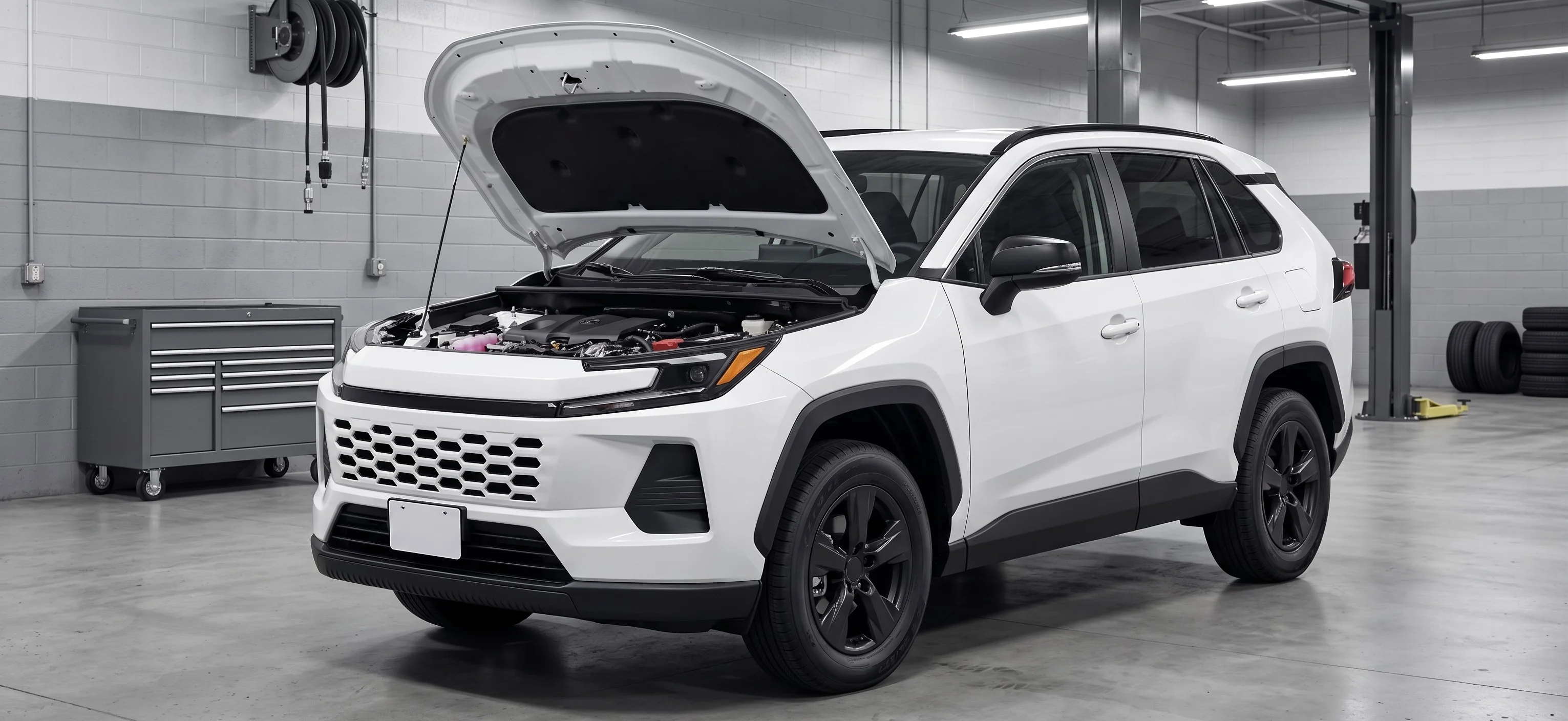
How do you know if your Toyota hybrid battery is wearing out? It’s one of the most common questions our service team hears from hybrid owners. Toyota hybrid systems are engineered to last for the vast majority of your ownership experience, but the high-voltage traction battery is a wear item that can gradually degrade over many years and hundreds of thousands of miles. Recognizing the early warning signs lets you address a weakening battery before it strands you or quietly erodes your fuel economy.
Recognizing the Warning Signs of a Failing Toyota Hybrid Battery
A weakening traction battery usually announces itself gradually. Watch for these signs:
Dropping Fuel Economy
If your hybrid suddenly needs more gasoline to cover the same routes, the system may be leaning harder on the gas engine to compensate for a weakening traction battery.
Fluctuating Charge Gauge
A state-of-charge gauge that swings from near-full to near-empty within a few minutes of driving can signal cells that are struggling to hold a steady charge.
Engine Runs Constantly
The gas engine running almost non-stop—even at a stop light or coasting at low speed—may mean the hybrid system can no longer rely on electric power alone.
Loud Cooling Fan
A battery cooling fan running at high speed with a loud, persistent hum is often working overtime to cool aging cells.
“Check Hybrid System” Warning
As issues escalate, onboard diagnostics typically trigger a master warning light along with a “Check Hybrid System” message on the dashboard.
If you notice any of these symptoms, it’s worth having a professional diagnostic scan performed. Our factory-trained technicians can read the specific diagnostic trouble codes to determine whether a single module or the full battery pack needs attention.
Understanding Your Toyota Hybrid Battery Warranty Coverage
What happens if your hybrid battery has a problem during your ownership? For all Toyota hybrid, plug-in hybrid, and fuel cell vehicles from the 2020 model year forward, Toyota provides a 10-year / 150,000-mile hybrid battery warranty (whichever comes first) covering defects in materials or workmanship. This is a meaningful upgrade over the previous 8-year / 100,000-mile term and offers real peace of mind for drivers who plan to keep their vehicles for a decade or more.
Key Coverage Facts at a Glance
- Length: 10 years / 150,000 miles, whichever comes first.
- Applies to: Toyota hybrid, plug-in hybrid, and fuel cell vehicles from the 2020 model year forward.
- Start date: The vehicle’s original date of first use when sold new.
- What it covers: Defects in materials or workmanship on the high-voltage battery.
- Transferable: Covers the first owner and all subsequent owners at no additional cost, which can help preserve resale value.
Two Layers of Hybrid Coverage
It’s worth knowing that Toyota structures hybrid coverage in two layers, both beginning at the vehicle’s in-service date:
- Hybrid battery: 10 years / 150,000 miles.
- Hybrid system components (inverter with converter, transaxle, and control modules): 8 years / 100,000 miles.
This information is provided for general educational purposes only and does not constitute legal advice. Warranty coverage depends on the specific terms of your vehicle’s warranty agreement. Consult your owner’s manual or a qualified legal professional for guidance on your individual situation.
How the Hybrid Battery Warranty Compares to Toyota’s Other Coverage
How does the hybrid battery warranty stack up against the other warranties protecting your Toyota? Toyota structures its coverage in tiers, with each component protected according to its expected lifespan. The hybrid traction battery receives the longest coverage of any major component on the vehicle—far outlasting the basic and powertrain terms.
| Coverage | Term | What It Protects |
|---|---|---|
| Basic (Bumper-to-Bumper) | 3 years / 36,000 miles | Most vehicle components against defects in materials or workmanship |
| Powertrain | 5 years / 60,000 miles | Engine, transmission, and drive systems |
| Hybrid System Components | 8 years / 100,000 miles | Inverter with converter, transaxle, and control modules |
| Hybrid Battery | 10 years / 150,000 miles | The high-voltage traction battery (2020 model year and newer) |
The hybrid battery’s coverage remains active long after the basic and powertrain terms have expired—protecting the vehicle’s most expensive electrified component well into its second decade of service.
Daily Driving Habits That Help Your Hybrid Battery Last
Can your daily driving habits actually influence how long your hybrid battery lasts? While Toyota’s battery-management software does most of the work regulating the state of charge, the way you accelerate, brake, and park can still help preserve the battery’s chemical health over time. A few simple habits reduce unnecessary stress on the system.
Brake and Accelerate Smoothly
- Favor smooth, progressive braking over sudden hard stops. Light, gradual brake pressure maximizes regenerative braking, which uses the electric motor to slow the vehicle and feed electricity gently back into the battery—far easier on the cells than abrupt, high-current events.
- Avoid unnecessary full-throttle acceleration. Using your eco-driving indicator helps keep the system in its optimal range and prevents the deep, rapid discharges that generate excess heat.
Mind the Heat
Environmental factors matter too. High ambient temperatures are one of the primary drivers of accelerated battery degradation, so parking in a garage or under shade whenever possible helps—especially through the warm months here in the Glendale area.
Hybrid Battery Cooling System Care and Filter Maintenance
What’s the most overlooked hybrid-specific maintenance item? Many drivers are surprised to learn the hybrid battery has its own dedicated cooling system, complete with an air filter that needs periodic attention. Because the high-voltage battery is typically located beneath the rear seats or cargo floor, it draws cabin air through an intake vent to keep the battery modules within their optimal temperature range.
Why the Filter Matters
Toyota recommends inspecting the hybrid battery cooling filter as part of your regular scheduled maintenance. If you frequently carry pets or drive in dusty conditions, this filter can become clogged with hair, lint, and road dust. A clogged filter restricts airflow to the pack, letting internal temperatures climb—and when the battery runs hot, the vehicle’s computer limits hybrid performance and leans on the gas engine to prevent thermal damage, which directly reduces fuel economy.
What Our Technicians Check
Cleaning or replacing this filter is a simple, low-cost preventive measure. During a routine visit, our technicians can:
- Inspect the battery cooling fan.
- Clean the intake duct.
- Replace the cooling filter.
Keeping this filter clear is a smart way to protect a major component for very little money.
What a Hybrid Battery Replacement Actually Costs
How should the possibility of a hybrid battery replacement factor into your long-term planning? Many owners worry about this expense, but the reality is reassuring: because Toyota hybrid batteries routinely last well beyond 150,000 miles, the large majority of original owners never pay for a replacement at all.
What to Expect on Cost
If a replacement is eventually needed outside the warranty period, here’s the general picture:
| Item | What to Know |
|---|---|
| Genuine Toyota battery pack, installed at a dealership | Commonly $3,500 to $8,000 or more, depending on the model and the labor involved to access the pack, with plug-in hybrid packs at the higher end |
| Likelihood you’ll pay it | Low — Toyota hybrid batteries routinely last well beyond 150,000 miles, so most original owners never pay for a replacement |
| Offsetting factor | Ongoing fuel savings over years of ownership, which for most drivers far outweigh the odds of an out-of-warranty replacement |
Replacement-cost ranges above reflect 2026 dealership pricing reported by independent automotive outlets and vary by model, region, and labor; Toyota does not publish a flat installed replacement price. Contact our service department for current pricing on your specific model.
Rule Out the Simple Fix First
If your dashboard shows a hybrid warning, it’s worth knowing that a weak 12-volt auxiliary battery can sometimes trigger hybrid-related warnings that are mistaken for traction-battery failure. A proper diagnostic tells you exactly what’s going on before any major work is authorized.
The information in this article is general guidance and does not constitute a specific diagnostic or repair recommendation for any individual vehicle. Repair and maintenance decisions should be made in consultation with a certified technician based on the specific condition of your vehicle.
Common Questions About Toyota Hybrid Battery Care
Does the Toyota hybrid battery warranty differ by state or region?
The 10-year / 150,000-mile hybrid battery warranty applies for Toyota hybrid, plug-in hybrid, and fuel cell vehicles from the 2020 model year forward. Separately, emissions-related warranty coverage can vary by state—in California and states that follow its emissions standards, certain high-voltage components may carry additional or longer coverage—so terms can differ based on where your vehicle was originally sold and registered. Refer to your Owner’s Warranty and Maintenance Guide for details specific to your vehicle.
Can you still drive a Toyota hybrid if the traction battery is completely dead?
No. The high-voltage traction battery is required for the vehicle to enter “Ready” mode and operate. If the traction battery fails completely, the vehicle will not run and will need service.
Does the hybrid battery charge when the vehicle is idling?
Yes. If the state of charge drops too low, the vehicle’s computer can start the gas engine to spin the motor-generator and charge the pack. That said, idling is not an efficient way to charge—regenerative braking and normal driving do it far better.
What happens to the old hybrid battery after it’s replaced?
Toyota operates a recycling and repurposing program so that spent hybrid batteries are kept out of landfills, with recovered materials repurposed rather than discarded.
Does using “EV Mode” frequently shorten battery life?
No. Using EV Mode for short, low-speed distances doesn’t harm the battery—the vehicle’s computer automatically restarts the gas engine before the charge drops to a level that could stress the cells.
Schedule Your Hybrid Service at Toyota of Glendale
Keeping up with your hybrid battery and cooling system is the simplest way to protect your fuel efficiency and reliability for the long haul. Whether you need a diagnostic health check, a hybrid cooling filter cleaning, or a multi-point inspection, our factory-trained technicians have the specialized tools and training to keep your hybrid performing at its best. Our service department uses genuine Toyota parts designed for your vehicle’s powertrain.
If you’ve noticed a change in your fuel economy or want your battery system evaluated, we’re here to help. You can get directions to our Glendale service center, or call our service advisors directly at 818-528-5070 to schedule an appointment.
Disclaimers
The information in this article is general guidance and does not constitute a specific diagnostic or repair recommendation for any individual vehicle. Repair and maintenance decisions should be made in consultation with a certified technician based on the specific condition of your vehicle.
This information is provided for general educational purposes only and does not constitute legal advice. Warranty coverage depends on the specific terms of your vehicle’s warranty agreement. Consult your owner’s manual or a qualified legal professional for guidance on your individual situation.
Replacement-cost ranges above reflect 2026 dealership pricing reported by independent automotive outlets and vary by model, region, and labor; Toyota does not publish a flat installed replacement price. Contact our service department for current pricing on your specific model.