Open Today Sales: 9 AM-9 PMOpen Today Service: 7 AM-7 PM
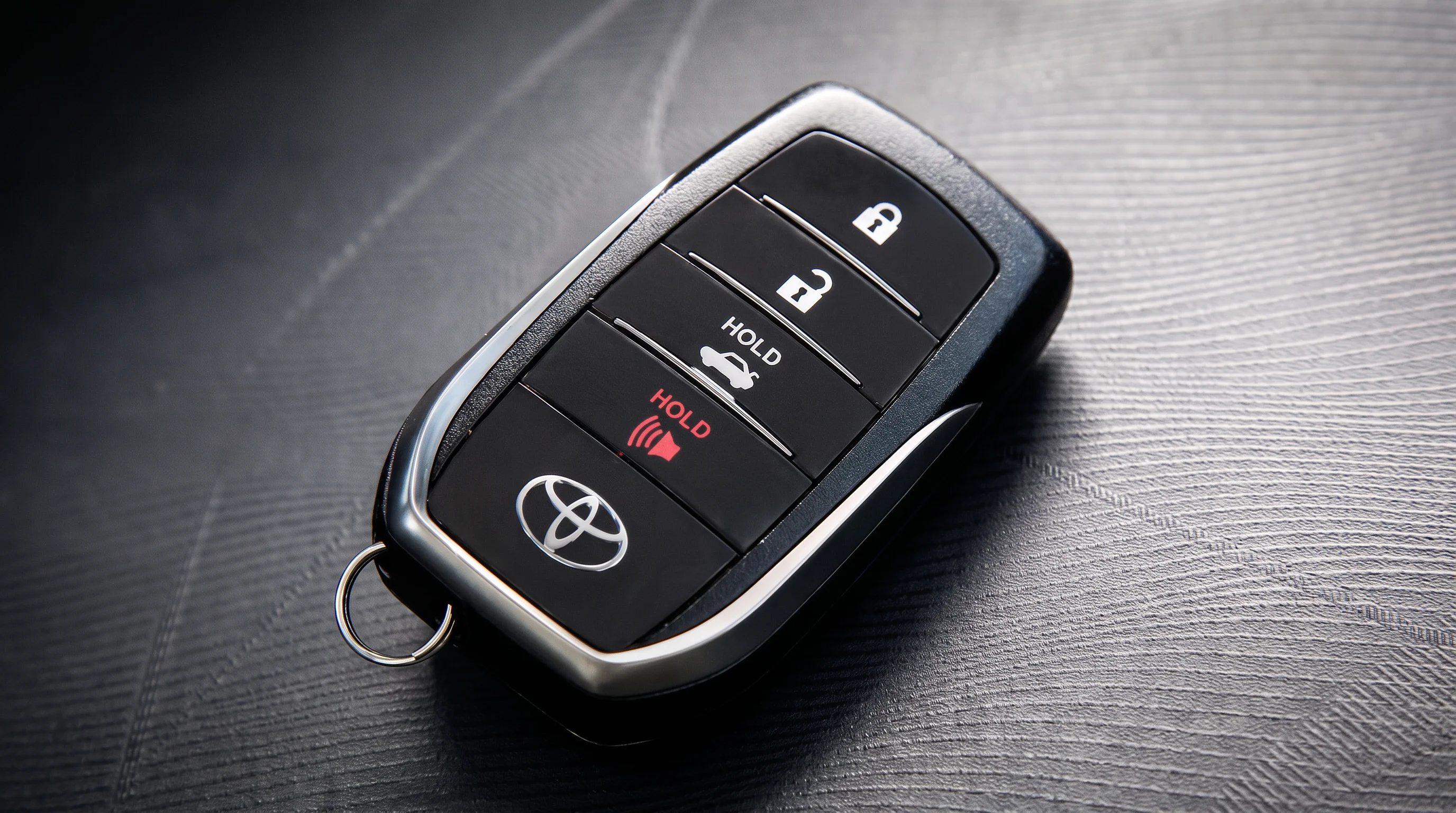
Replacing a Toyota key fob battery takes about five minutes and needs nothing more than a small flathead screwdriver and the right coin cell. The one thing worth checking first: Toyota does not use the same battery in every key. Depending on your model, model year, and whether your vehicle has a smart key system, the correct cell may be a CR2450, CR2032, CR2016 or CR1632 — so confirm yours in the electronic key section of your Toyota owner’s manual before you buy one.
If you’d rather not pry open a smart key yourself, our service team handles it. Toyota of Glendale includes a free key fob battery replacement with the Toyota Full Synthetic Oil Change service, and with the Road Trip Package. Call our service center at 818-528-5070 or stop by 1260 S Brand Blvd in Glendale.
There is no single answer, and that is the most common reason a replacement fails. Toyota specifies the coin cell per vehicle in the owner’s manual, and the published specification has changed across models and model years. The table below lists the cells Toyota has specified for its electronic keys and remotes, with the physical specifications for each.
| Coin cell | Diameter | Thickness | Nominal voltage | Nominal capacity | Toyota application confirmed in an owner’s manual |
|---|---|---|---|---|---|
| CR2450 | 24.5 mm | 5.0 mm | 3 volts | 620 mAh | Current-model-year Sienna electronic key |
| CR2032 | 20.0 mm | 3.2 mm | 3 volts | 225 mAh | Earlier Sienna electronic key and wireless remote |
| CR1632 | 16.0 mm | 3.2 mm | 3 volts | 140 mAh | Older Toyota models with a smart key system |
| CR2016 | 20.0 mm | 1.6 mm | 3 volts | 90 mAh | Older Toyota models without a smart key system |
| CR2025 | 20.0 mm | 2.5 mm | 3 volts | 165 mAh | Not a Toyota specification — listed because it is the cell most often grabbed by mistake instead of a CR2032 |
Every one of these is a 3-volt lithium cell, so voltage is never what distinguishes them. Size is. A CR2450 is half again as thick as a CR2032 and will not fit its holder; a CR2025 will drop into a CR2032 holder and then lose contact because it is 0.7 mm too thin.
The code is a measurement, not a part number. The two letters describe the chemistry and shape — CR is a lithium manganese dioxide cell in a round can. The four digits are millimeters: the first two are the diameter, the last two are the thickness in tenths of a millimeter. A CR2032 is 20 millimeters across and 3.2 millimeters thick. A CR1632 is 16 millimeters across and the same 3.2 millimeters thick.
Once the case is open, the code is stamped on the face of the old cell. That stamp is the most reliable confirmation you can get, because it is the battery your vehicle actually shipped with.
A small one. Some Toyota manuals call for a second, smaller driver to separate the inner case.
Painter’s tape or a thin microfiber cloth to pad the screwdriver tip.
Matched to your vehicle’s owner’s manual, not assumed from another Toyota.
Dry and uncluttered, so a dropped cell doesn’t disappear.
Toyota’s own instructions call for covering the tip of the screwdriver with a rag before opening the key. The cloth spreads the prying force across the seam so the plastic clips separate without gouging or cracking the housing.
Toyota lists three precautions for this job. Always work with dry hands, because moisture can cause the battery to rust. Don’t touch or move any other components inside the remote. And don’t bend either of the battery terminals.
The information in this article is general guidance and does not constitute a specific diagnostic or repair recommendation for any individual vehicle. Repair and maintenance decisions should be made in consultation with a certified technician based on the specific condition of your vehicle.
Toyota puts the standard battery life of a key at one to two years, and the owner’s manual states the same figure for vehicles with a smart key system and for vehicles without one. If you have read that a key fob battery should last five years or more, that is not Toyota’s published figure for these vehicles.
The reason the life is shorter than most drivers expect is in how the key works. Toyota notes that the battery becomes depleted even if the electronic key is not used, because the key is always transmitting. A spare that spends the year in a drawer is on roughly the same clock as the one in your pocket — which is why a backup key often turns out to be dead on the day you finally need it.
Lithium coin cells are also rated for a specific temperature window, and sustained heat sits at the edge of it. A key left on a dashboard through a Southern California summer is working harder than one kept indoors.
Toyota lists a specific set of symptoms for a depleted key:
The smart key system or the wireless remote no longer functions properly.
The detection area gets smaller, so you have to stand closer to the door handle.
On keys with an indicator light, it no longer comes on when a button is pressed.
Your Toyota will usually warn you before it strands you. When the charge drops, an alarm sounds inside the cabin when the engine or hybrid system is switched off, and a low key battery message appears on the multi-information display telling you to replace it. If you’re not sure what a cluster message is telling you, our guide to dashboard warning lights covers the most common ones.
The shrinking detection range is worth understanding, because it’s easy to misread as a door handle fault. Toyota’s smart key system is designed to work when the key is within about 2.3 feet of an outside door handle. That window is small to begin with, so as the cell weakens the car stops noticing the key in your pocket until you are practically touching the handle.
A dead key fob does not strand you. Every Toyota with a smart key system has a backup method built in, and it is worth reading before you need it.
To get into the vehicle, pull the mechanical key out of the fob and use it on the driver’s door. The mechanical key is also what you use if the smart key system has been switched off in the customization settings, or if battery-saving mode has engaged.
To start the vehicle, Toyota’s published sequence is:
Two things vary by model and are worth confirming in your own manual: which face of the key has to contact the switch, and how long the detection window stays open after the buzzer. Have your foot on the brake before you touch the key to the switch so you are not rushing that step.
Toyota treats this as a temporary measure and recommends replacing the key battery immediately once it is depleted.
The information in this article is general guidance and does not constitute a specific diagnostic or repair recommendation for any individual vehicle. Repair and maintenance decisions should be made in consultation with a certified technician based on the specific condition of your vehicle.
No. A Toyota electronic key keeps its pairing with the vehicle when the battery comes out. There is no re-registration or reprogramming step anywhere in Toyota’s battery replacement procedure — it is published as do-it-yourself maintenance, alongside cabin air filters and fuses. Leaving the cell out for hours or days does not erase anything.
If the key still won’t lock or unlock the vehicle after a fresh battery goes in, the cause is almost always mechanical rather than electronic:
Check that the plus side faces up, confirm the code on the new cell matches the one you removed, wipe the faces of the cell with a clean dry cloth, and gently flex any bent terminal back into contact.
The information in this article is general guidance and does not constitute a specific diagnostic or repair recommendation for any individual vehicle. Repair and maintenance decisions should be made in consultation with a certified technician based on the specific condition of your vehicle.
It depends on the vehicle. Toyota specifies the cell per model in the owner’s manual, and confirmed specifications include CR2450, CR2032, CR1632 and CR2016. Check the electronic key section of your owner’s manual, or read the code stamped on the face of the old cell once the case is open. Do not assume another Toyota in the driveway takes the same one.
Both are 3-volt lithium coin cells with the same 20 millimeter diameter. The CR2032 is 3.2 millimeters thick and rated at 225 milliamp hours; the CR2025 is 2.5 millimeters thick and rated at 165 milliamp hours. The thicker CR2032 holds more charge and lasts longer. Because the only difference is thickness, the two are easy to confuse on a shelf, and a CR2025 dropped into a CR2032 holder can sit loose and lose contact. Match the code stamped on the cell you took out.
No. Driving position memory is recorded to buttons inside the vehicle and linked to a key, not stored inside the fob. Climate and vehicle settings live in the vehicle’s own electronics. Once fresh power reaches the transmitter, the key resumes working with all of your existing settings intact.
Check four things in order: that the cell is the size your manual specifies, that the plus side faces up as the diagram inside the case shows, that the contact surfaces are clean and dry, and that none of the small metal prongs were bent down during removal. A cell that is the right diameter but too thin is the most commonly missed cause, because it looks correct in the holder.
The information in this article is general guidance and does not constitute a specific diagnostic or repair recommendation for any individual vehicle. Repair and maintenance decisions should be made in consultation with a certified technician based on the specific condition of your vehicle.
Yes. If the key is still unresponsive with a known-good battery, the problem may be the transmitter, the housing seals, or a worn key blade rather than the cell. Our factory-trained technicians can confirm which cell your key takes, check the key itself, and replace worn casings or blades with genuine Toyota parts.
For most drivers this is a five-minute job worth doing at home, provided you start with the right cell. The tools are already in a kitchen drawer, and Toyota publishes the procedure as owner maintenance.
Bring it to us when you are not certain which battery your key takes, when the key keeps failing after a fresh cell, when the housing is cracked or the seals look worn, or when you simply don’t want to pry open a smart key with a screwdriver. Our technicians work on Toyota keys every day, and the battery replacement is included free with a Toyota Full Synthetic Oil Change or the Road Trip Package — so if you are due for service anyway, there is no reason to buy the cell yourself.
Toyota of Glendale serves drivers across Glendale, Los Angeles, Pasadena, Hollywood, North Hollywood and Van Nuys. Call our service center at 818-528-5070, schedule online, or stop by 1260 S Brand Blvd in Glendale. You can also browse more Toyota service and parts tips for other maintenance you can handle yourself.
The information in this article is general guidance and does not constitute a specific diagnostic or repair recommendation for any individual vehicle. Repair and maintenance decisions should be made in consultation with a certified technician based on the specific condition of your vehicle.
The 2026 Toyota Camry LE AWD and SE AWD share the same hybrid powertrain. Both make 232 net combined horsepower with Electronic On-Demand All-Wheel Drive, so the choice comes down to priorities. The LE AWD has the lower starting price and the higher EPA-estimated fuel economy. The SE AWD adds a sport-tuned suspension, 18-inch black-finished…
Contáctenos Ver Inventario de Camry Nuevos ¿Qué motor y opciones de tren motriz híbrido ofrece el Toyota Camry 2026? El Toyota Camry 2026 está equipado exclusivamente con el sistema híbrido de quinta generación de Toyota. Este sistema combina un motor de cuatro cilindros y 2.5 litros con motores eléctricos y una transmisión eCVT. La configuración…
Ver Inventario de Camry Nuevos Contáctanos El Toyota Camry Híbrido 2026 alcanza hasta 51 mpg combinados estimados por la EPA. Esa cifra corresponde a la versión LE con tracción delantera y es la más alta de la gama. La versión LE con tracción integral (AWD) registra 50 mpg combinados estimados por la EPA. Es una…