

How Often Should You Rotate Your Tires?
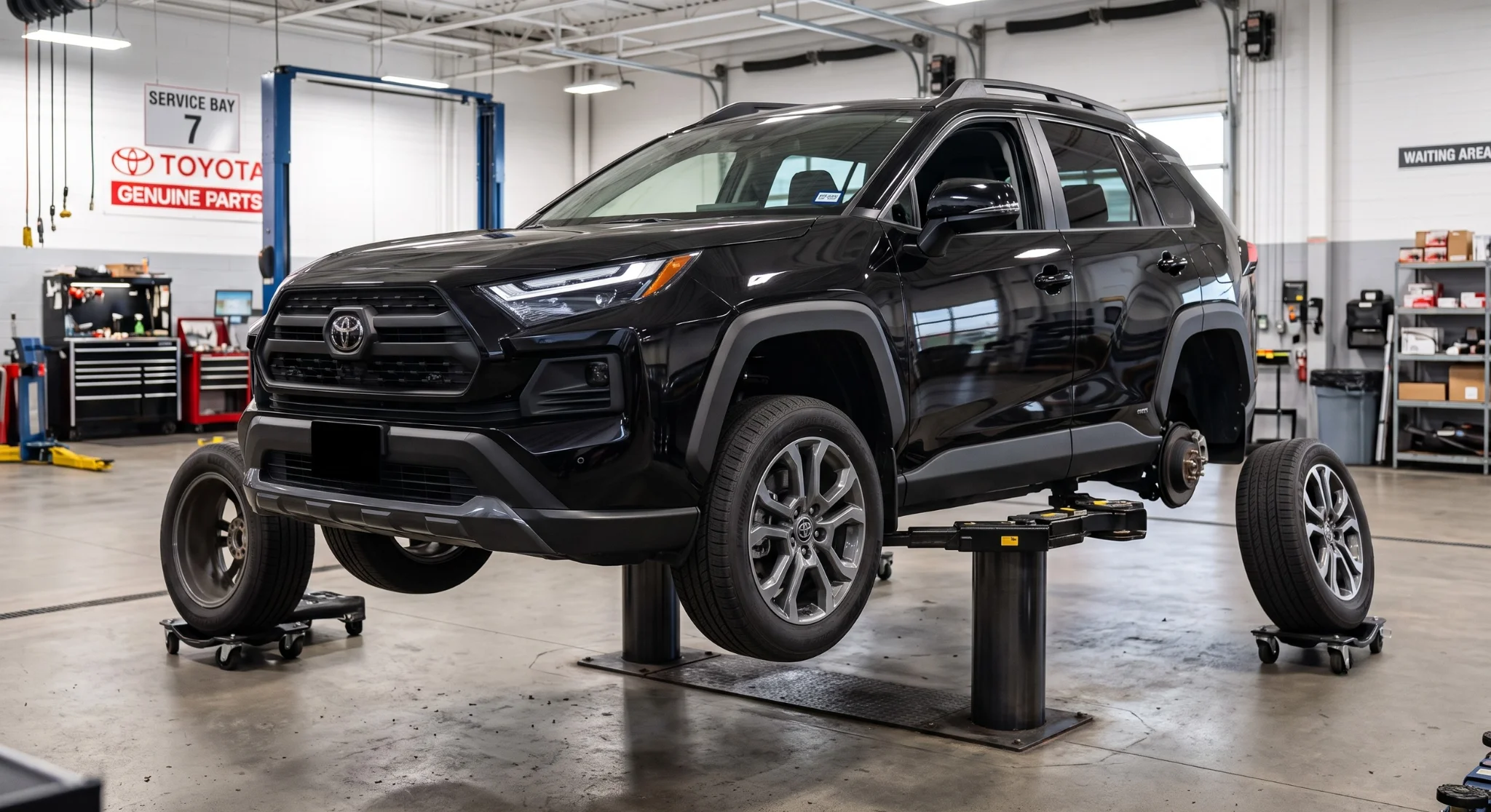
Rotating your tires on a regular schedule is one of the simplest and most cost-effective ways to protect your vehicle’s ride quality, safety, and tire investment. For most passenger vehicles, the accepted service interval is every 5,000 to 7,500 miles, or roughly every six months — whichever comes first. Because that window lines up neatly with most oil change and multi-point inspection schedules, it’s easy to group tire rotation into a service visit you’re already making.
The right interval and rotation pattern depend on your vehicle’s drivetrain, because front-wheel-drive, rear-wheel-drive, and all-wheel-drive systems distribute power and wear differently. For more maintenance guidance, explore our service and parts tips or visit the Toyota of Glendale service department.
How Often to Rotate by Drivetrain
All-wheel-drive vehicles wear all four tires at slightly different rates as the system shifts power between axles, so keeping tread depths closely matched protects the driveline as well as the tires. Your owner’s manual always takes precedence over any general interval.
| Drivetrain | Recommended Interval | Why |
|---|---|---|
| Front-wheel drive (FWD) | 5,000–7,500 mi / ~6 mo | Front tires steer, drive, and brake — they wear faster |
| Rear-wheel drive (RWD) | 5,000–7,500 mi / ~6 mo | More even front/rear split, but rotation still balances wear |
| All-wheel drive (AWD) | 3,000–5,000 mi | Power shifts between axles; matched tread protects the driveline |
Tire Rotation Patterns by Drivetrain
The direction tires are moved during a rotation follows a standardized pattern set by drivetrain and tire type.
| Drivetrain | Pattern | Tire Movement |
|---|---|---|
| FWD | Forward cross | Fronts move straight to the rear; rears cross to the opposite front corners |
| RWD | Rearward cross | Fronts cross to the opposite rear corners; rears move straight to the front |
| AWD / 4WD | Rearward cross or X-pattern | Rears move straight forward; fronts cross to the opposite rear corners (or all four cross diagonally) |
| Directional tires | Front-to-back, same side | Stay on the same side of the vehicle; never crossed |
Directional tires — marked with a directional arrow on the sidewall — are the exception: they must stay on the same side of the vehicle and move straight front-to-back only, so the tread keeps rolling in its intended direction.
Pairing Rotation With Your Maintenance Schedule
The easiest way to never miss a rotation is to attach it to service you already schedule. Most modern vehicles follow a predictable maintenance progression, and tying rotation to your oil change or inspection means one appointment covers multiple items — while a technician gets eyes on your tires, brakes, and suspension every few thousand miles.
| Milestone | Service Performed |
|---|---|
| Every 5,000 mi / 6 mo | Tire rotation + tire pressure (PSI) check on all four |
| Every 10,000 mi / 12 mo | Rotation + wheel balancing to prevent high-speed vibration |
| Every 15,000–20,000 mi | Rotation + balance + wheel alignment check |
Why Front Tires Wear Faster
On front-wheel-drive vehicles, the front tires do most of the work at once: they put engine power to the road, handle steering, and carry the majority of braking force as weight shifts forward under braking. The engine and transmission also sit directly over the front axle, pressing those tires harder into the pavement. Left in place, front tires can wear noticeably faster than the rears — which is exactly why moving them to lighter-duty rear positions on a schedule evens out the wear.
How Rotation Protects Your Tire Warranty
Most treadwear warranties are mileage-based, and most are conditional. To honor a claim for premature or uneven wear, tire manufacturers typically require:
- Documented proof of rotation at the manufacturer’s recommended intervals
- A consistent service history (receipts showing dates and mileage)
- Evidence the tires weren’t run in a neglected or clearly uneven state
Skipped rotations are often treated as neglect, because letting one pair wear out prematurely is preventable. Consistent rotation keeps all four tires wearing at a uniform rate — which also means you can replace all four together and keep handling predictable, rather than buying mismatched pairs.
This information is provided for general educational purposes only and does not constitute legal advice. Warranty coverage depends on the specific terms of your vehicle’s warranty agreement. Consult your owner’s manual or a qualified legal professional for guidance on your individual situation.
Even Tread Wear Improves Safety
Your tires are the only contact point between your vehicle and the road, so even tread depth across all four matters for how the vehicle stops, corners, and holds the road:
- Braking & handling: Matched tread depth keeps braking balanced and cornering predictable, the way the vehicle was engineered to behave.
- Wet-weather grip: Deeper, even tread channels water away and resists hydroplaning; worn front tires lose steering grip on wet roads first.
- Safety systems: ABS and stability control work most effectively when all four tires have comparable grip, so the systems intervene less aggressively.
When You Need More Than a Rotation
A rotation evens out normal wear, but it can’t correct an underlying alignment or balance problem. Watch for these symptoms:
| Symptom | Likely Cause | Service Needed |
|---|---|---|
| Vibration or shaking that worsens at highway speed | Wheels out of balance | Wheel balancing |
| Vehicle pulls to one side on a flat, straight road | Alignment out of spec | Wheel alignment |
| Inner or outer shoulder wearing faster than the center | Incorrect camber/toe | Wheel alignment |
Impacts with potholes or curbs can knock a vehicle out of alignment. If you notice any of these symptoms, a rotation alone won’t fix it — a technician should perform a computerized alignment or wheel balancing. Watch for seasonal savings on our service specials page.
The information in this article is general guidance and does not constitute a specific diagnostic or repair recommendation for any individual vehicle. Repair and maintenance decisions should be made in consultation with a certified technician based on the specific condition of your vehicle.
Common Questions About Tire Rotation
Should I rotate based on time or mileage?
Primarily mileage — aim for every 5,000 to 7,500 miles. But if you drive very little, still have your tires rotated about every six months so a technician can inspect for dry rot, age cracking, and slow pressure leaks.
Is the interval different for all-wheel-drive vehicles?
Yes. AWD vehicles often need rotation more frequently — commonly every 3,000 to 5,000 miles — because the system constantly shifts power between axles, and closely matched tread depth protects the differential and transfer case.
Can I rotate my own tires at home?
It’s possible with proper jack stands, a torque wrench, and safety gear, but it’s usually best left to professionals. A technician can also check balance, inspect brakes and suspension with the wheels off, and torque the lug nuts to factory specification.
Do directional tires need a special pattern?
Yes. Directional tires roll in one direction only (marked by a sidewall arrow) and can’t be crossed side to side — they’re rotated straight front-to-back on the same side.
Schedule Tire Service at Toyota of Glendale
Regular tire care is a simple way to protect your vehicle’s safety, efficiency, and performance. Our factory-trained technicians handle everything from standard rotations and high-speed balancing to computerized wheel alignments, inspecting your tires, brakes, and suspension in the process.
You’ll find us at 1260 S Brand Blvd, Glendale, CA 91204. Book online through our service scheduler or call our service team at 818-528-5070 to set up your next visit.
Disclaimers
This information is provided for general educational purposes only and does not constitute legal advice. Warranty coverage depends on the specific terms of your vehicle’s warranty agreement. Consult your owner’s manual or a qualified legal professional for guidance on your individual situation.
The information in this article is general guidance and does not constitute a specific diagnostic or repair recommendation for any individual vehicle. Repair and maintenance decisions should be made in consultation with a certified technician based on the specific condition of your vehicle.